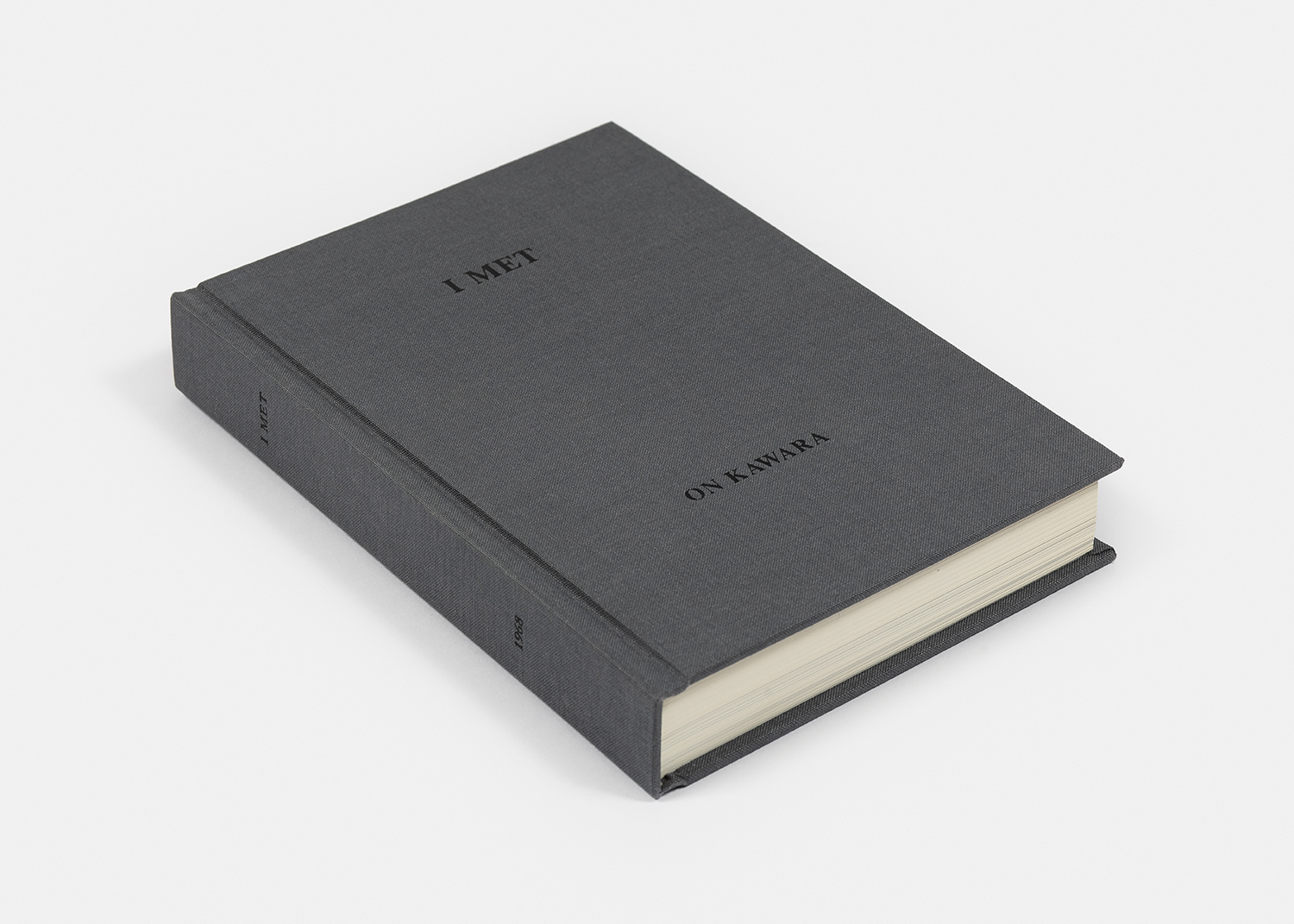
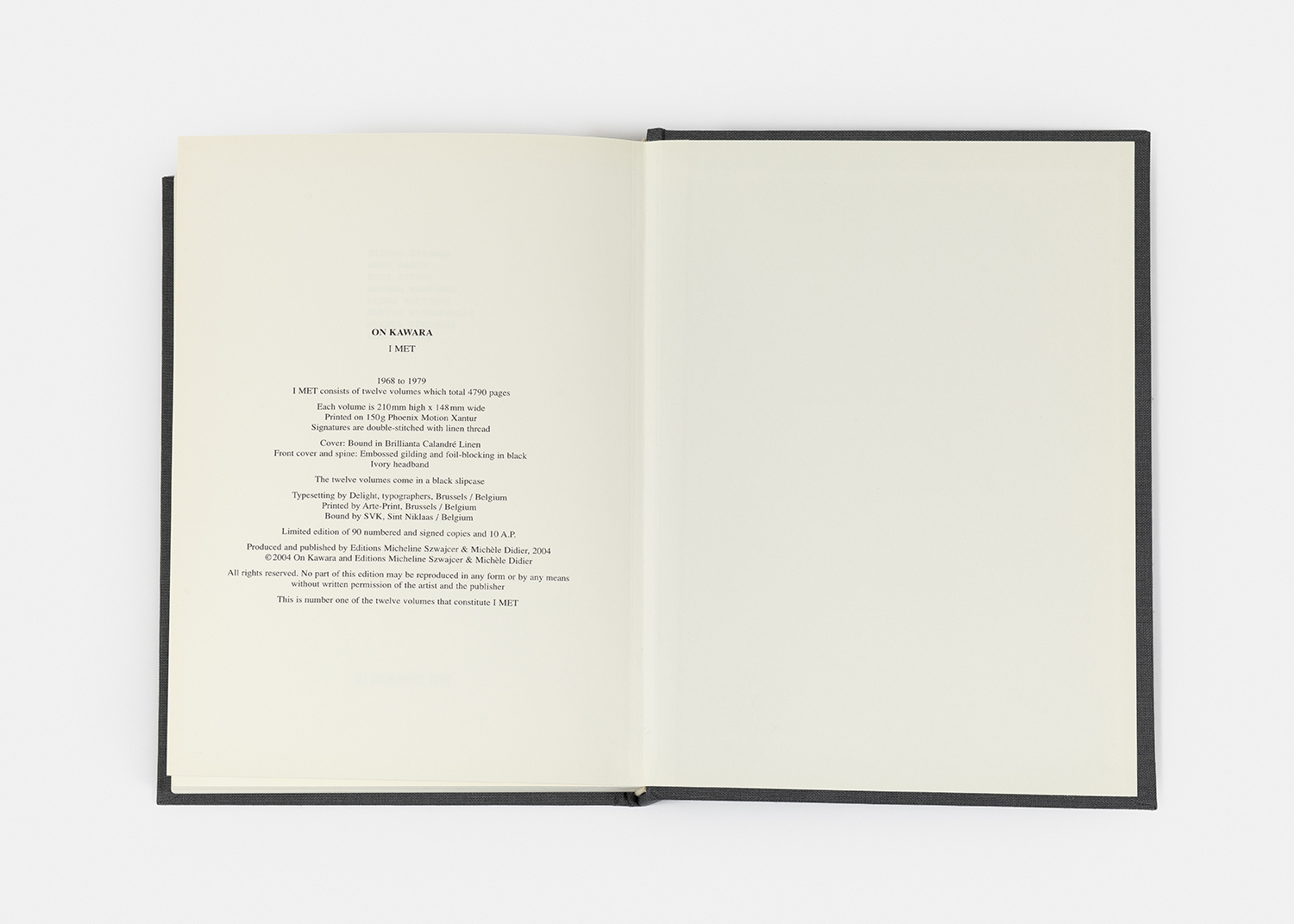
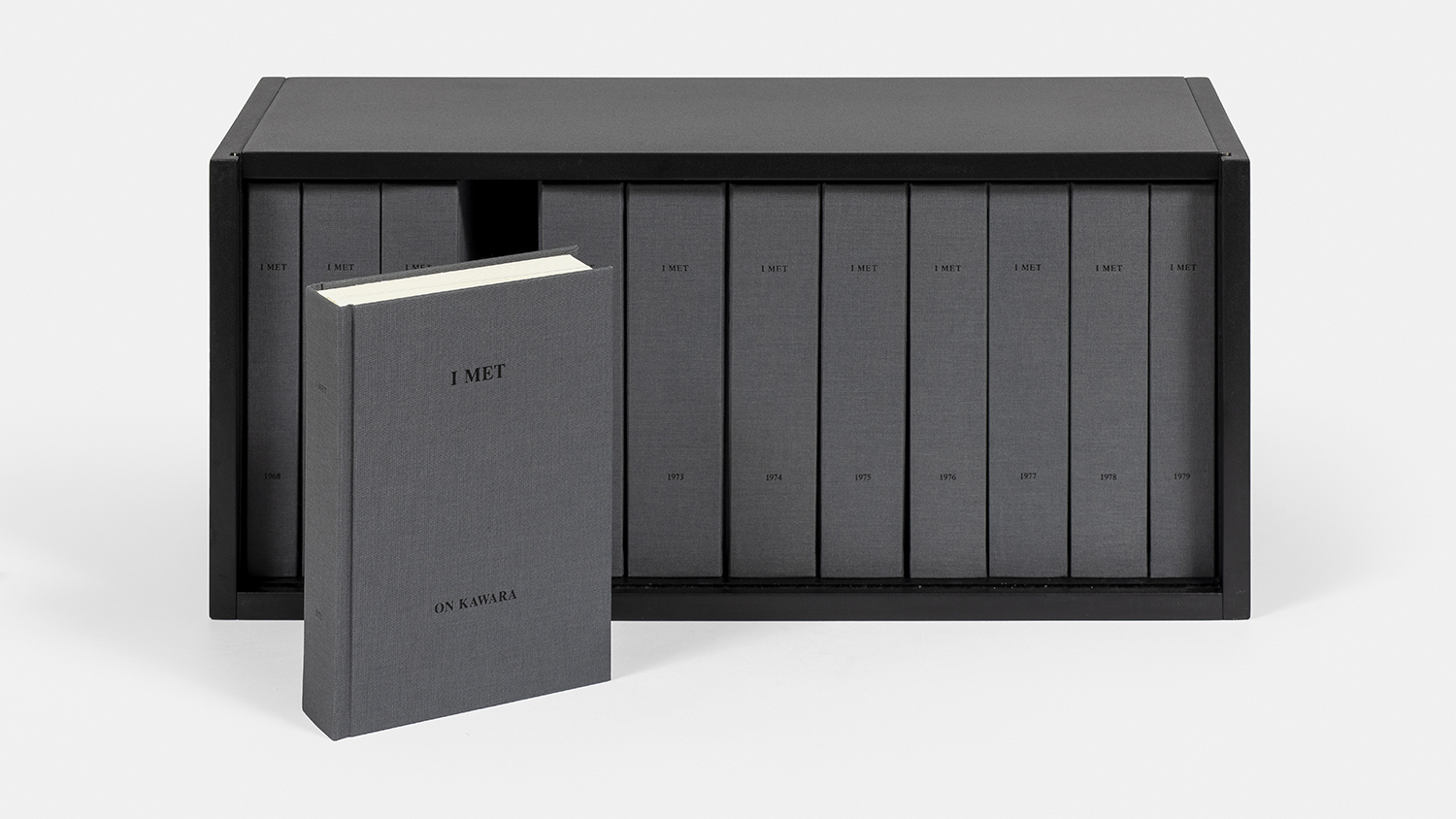
On Kawara I MET, 2004
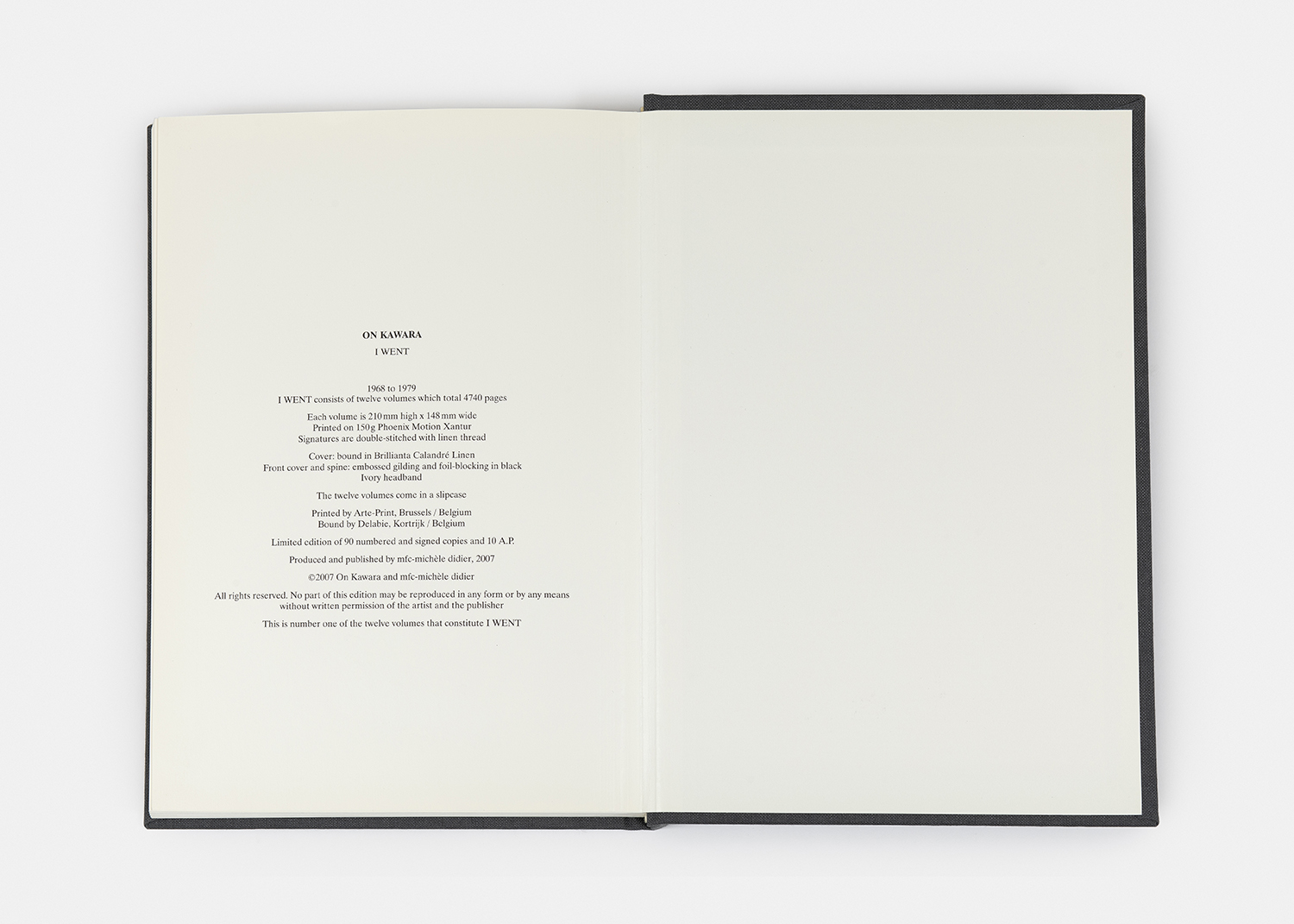
Specifications
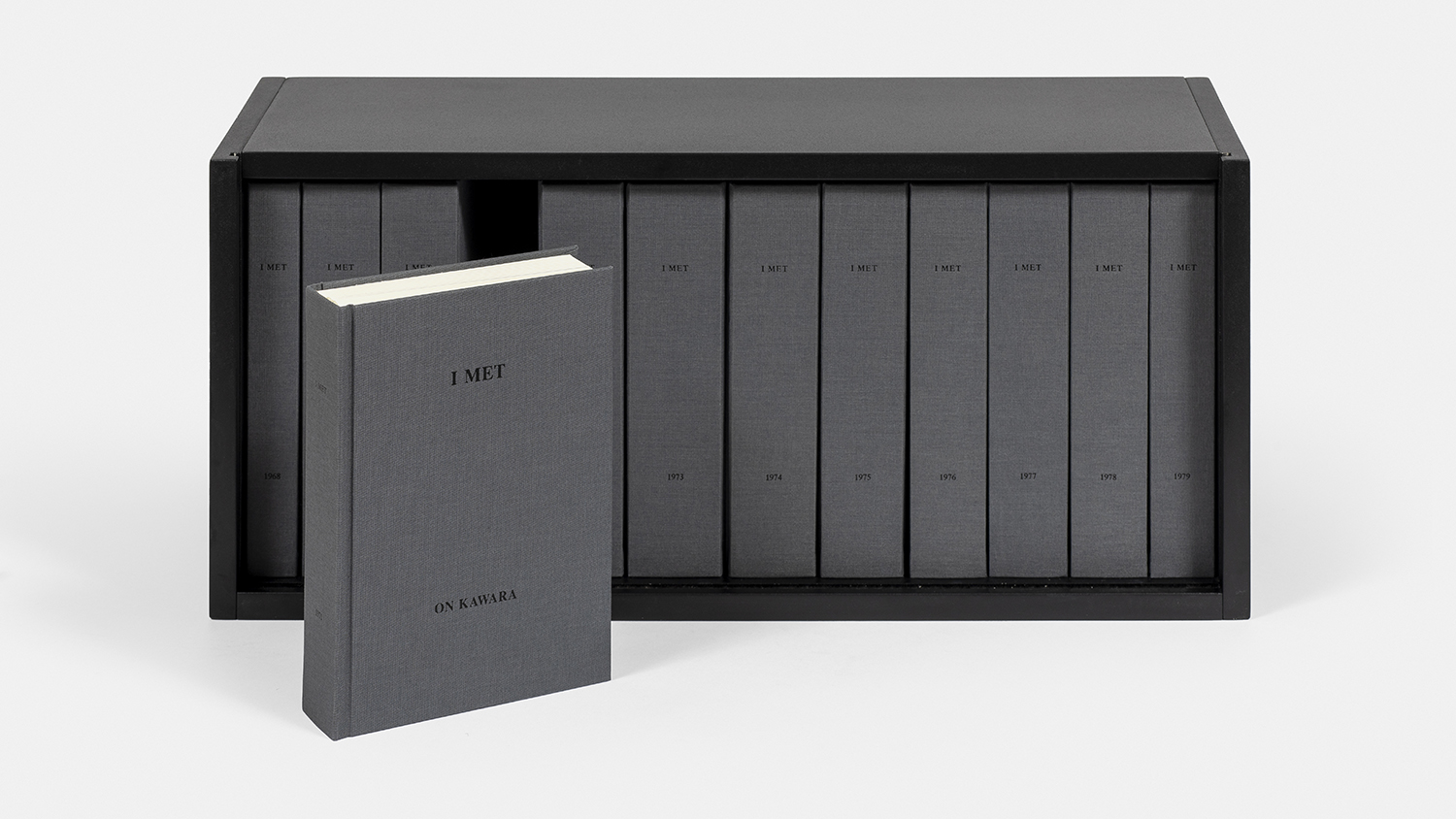
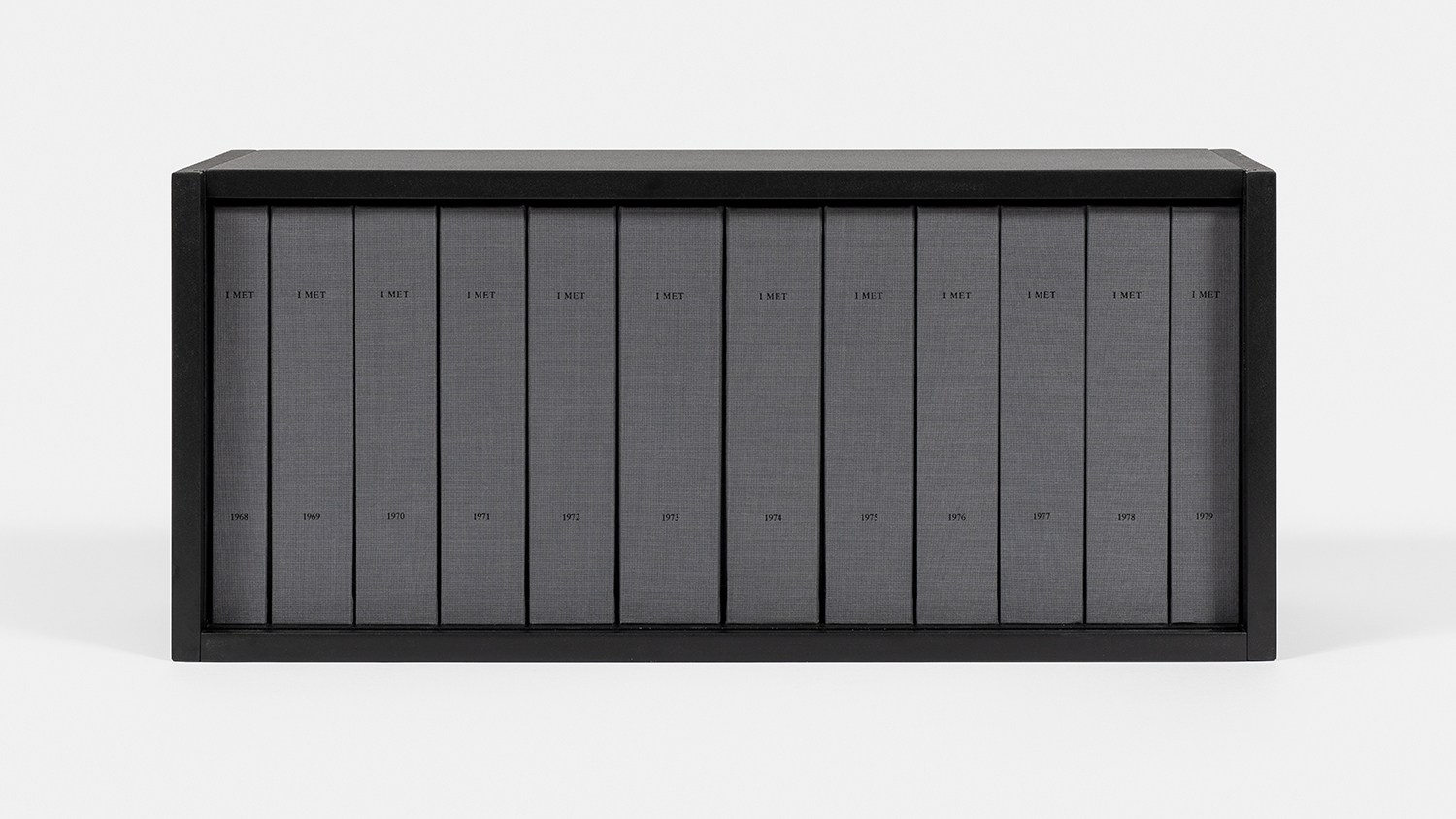
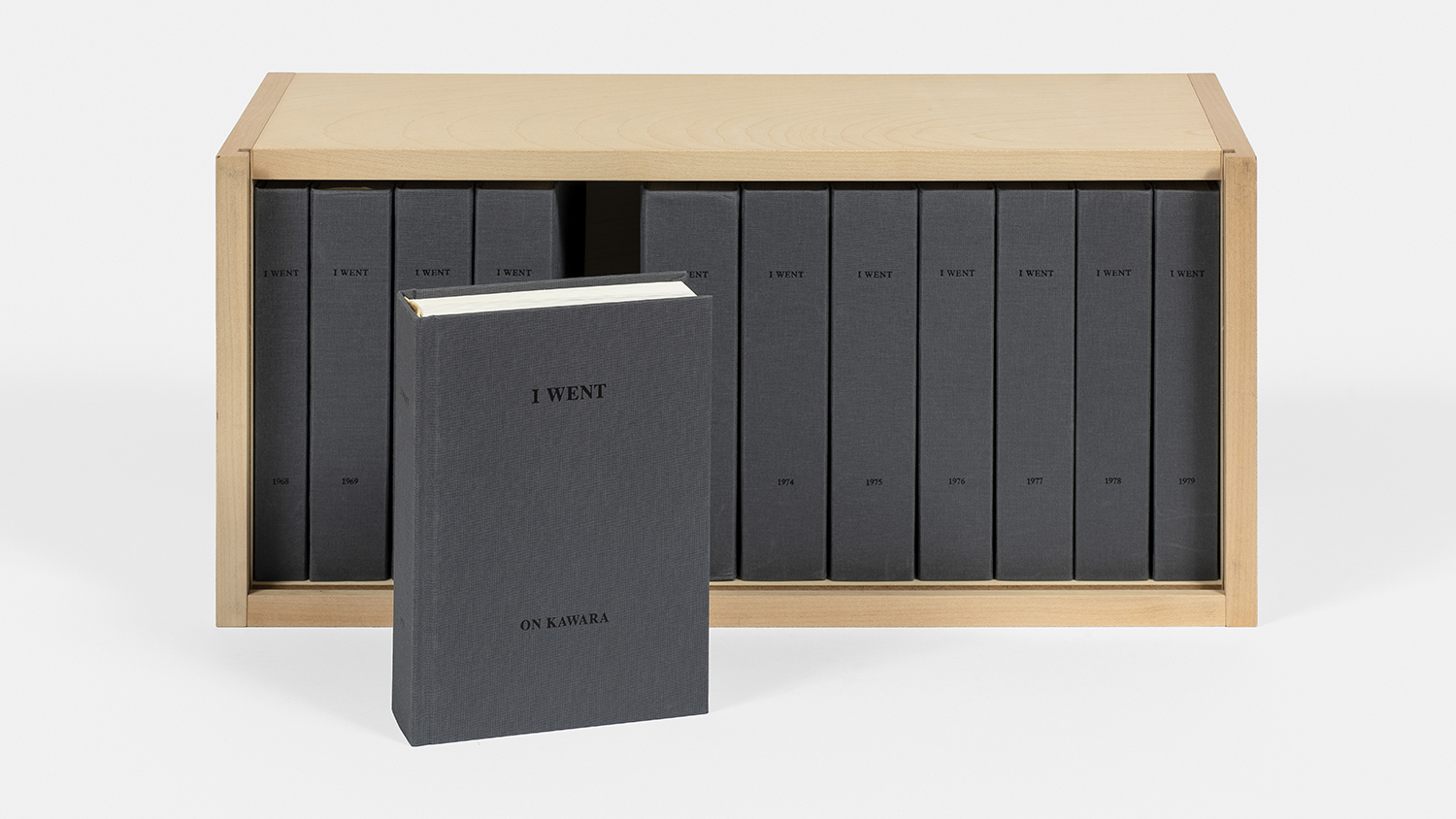
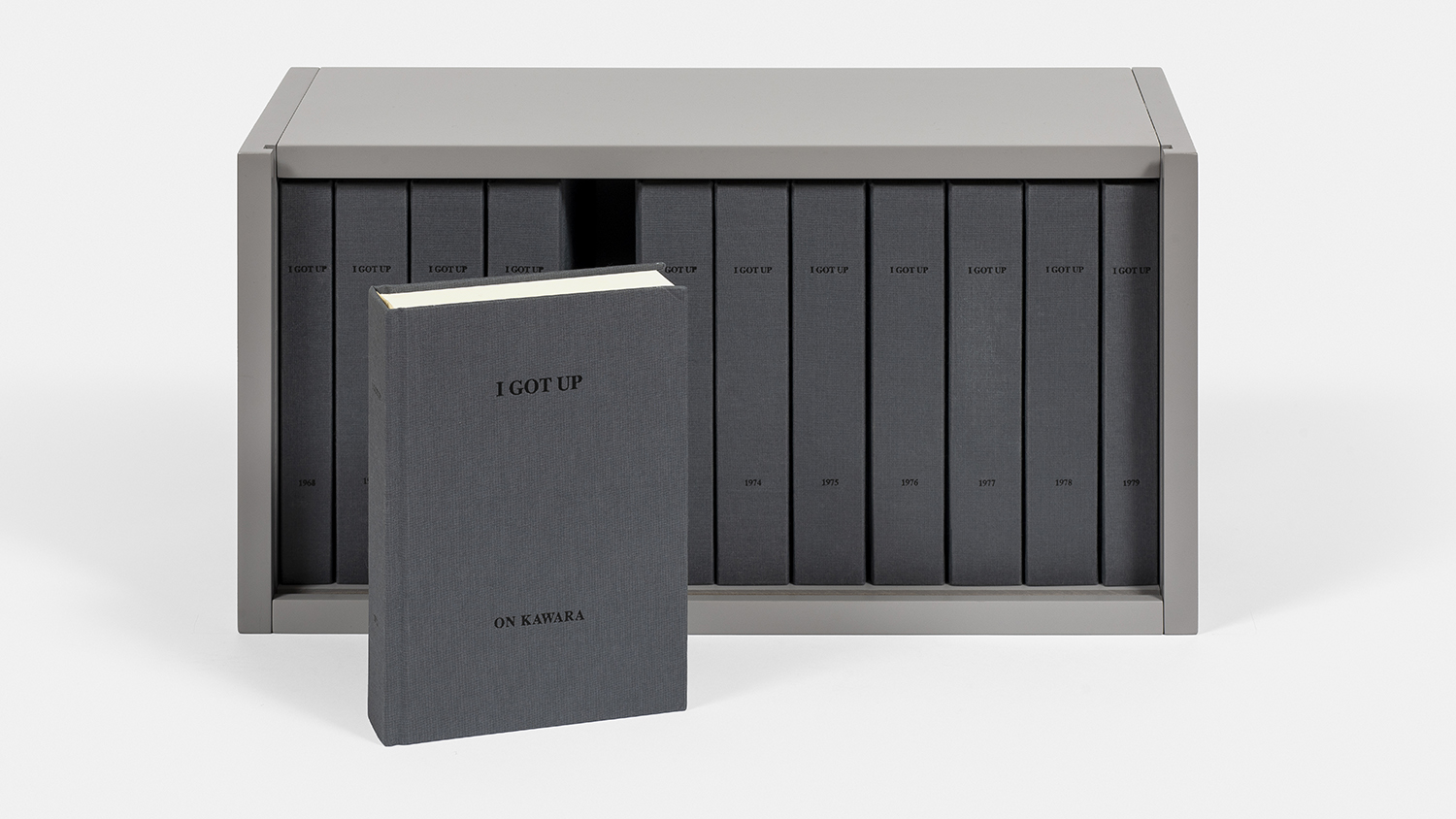
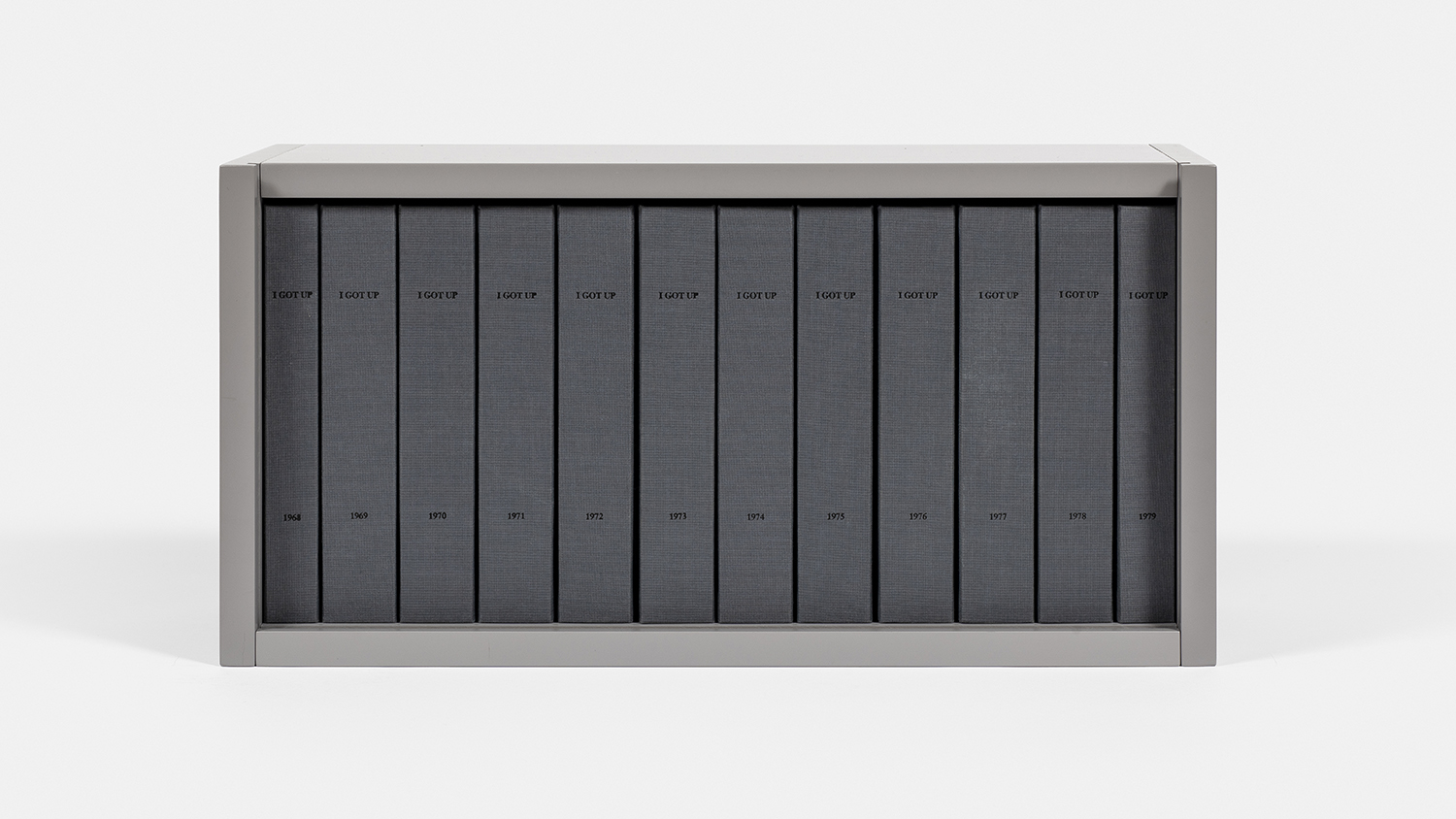
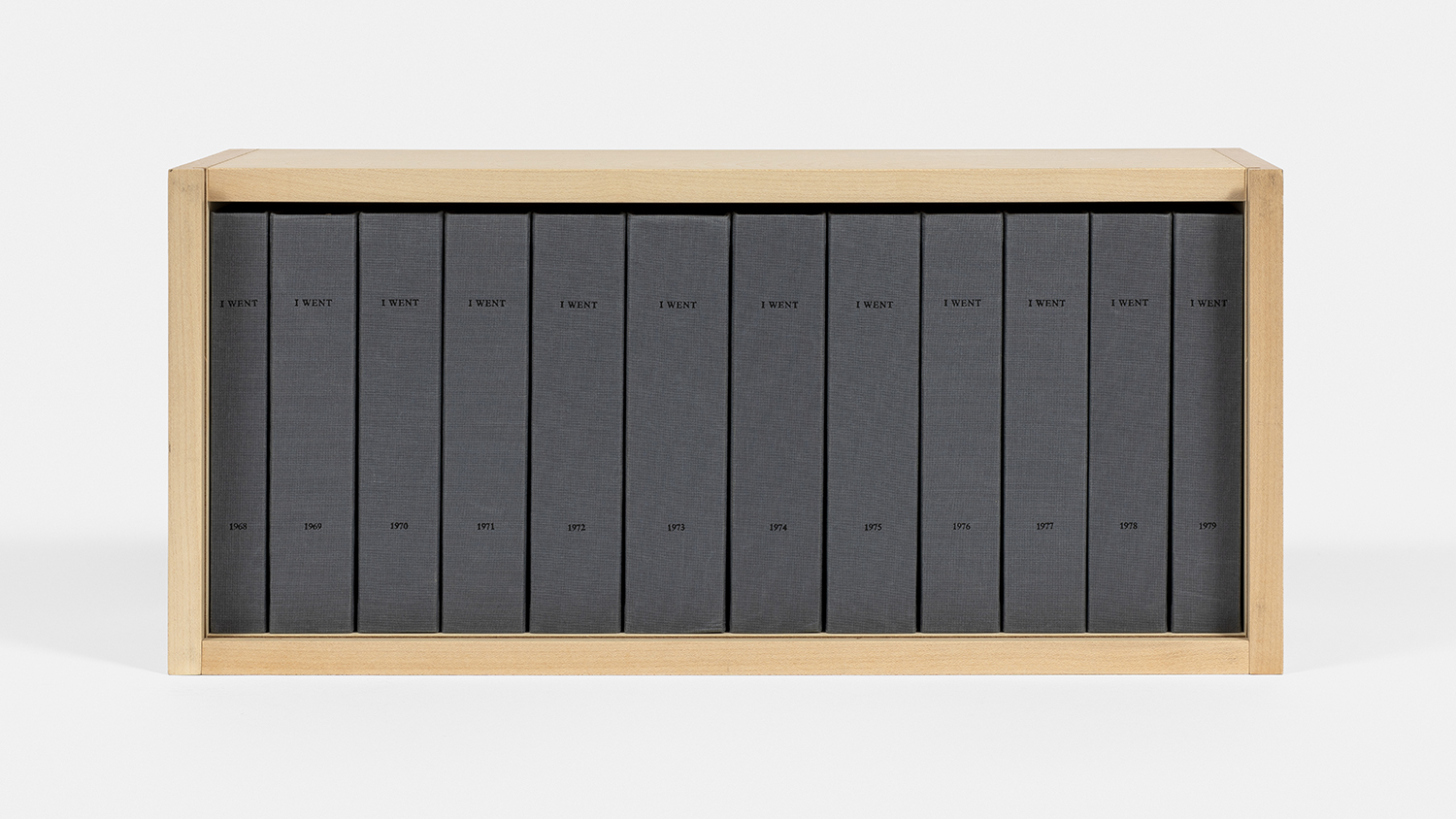
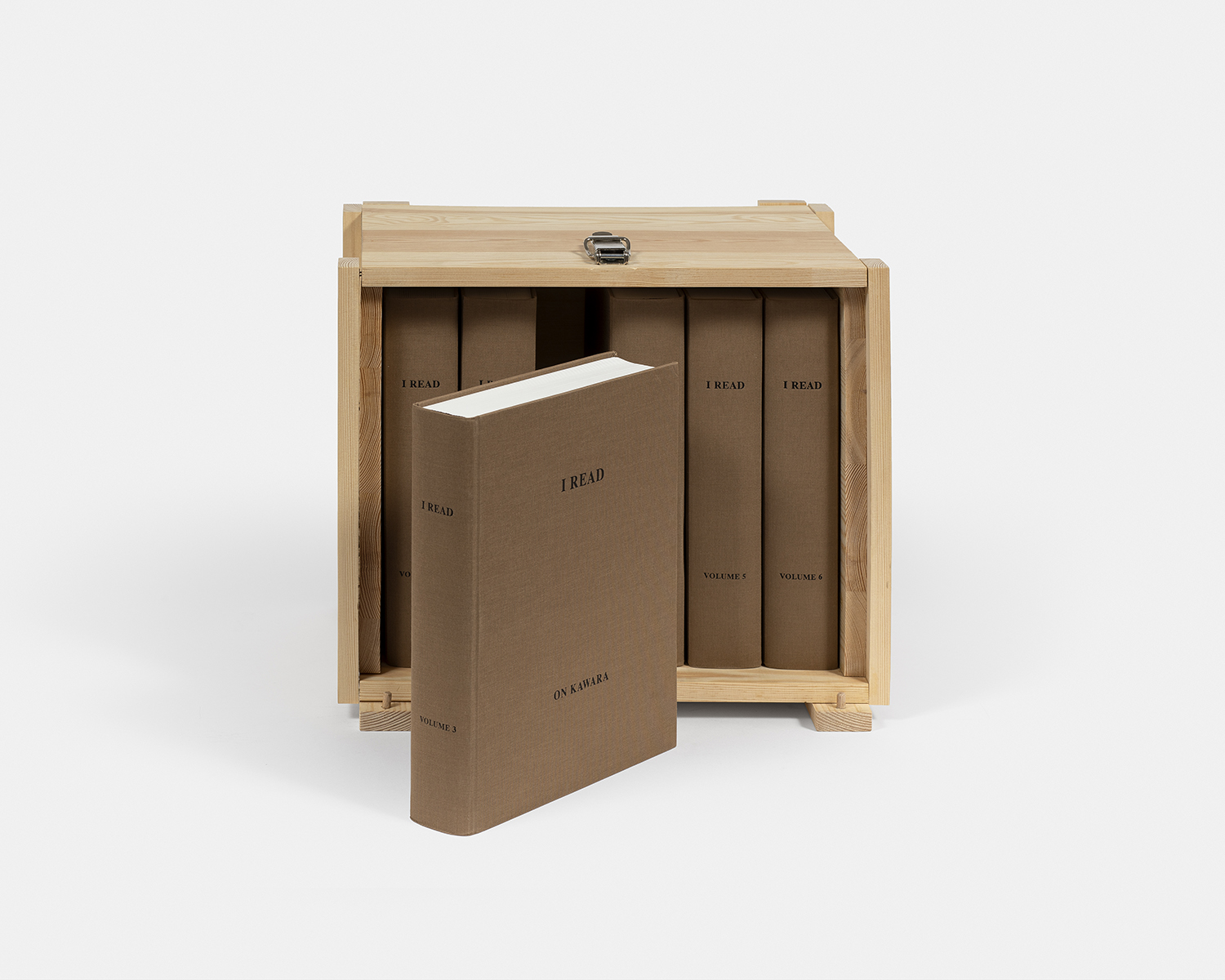
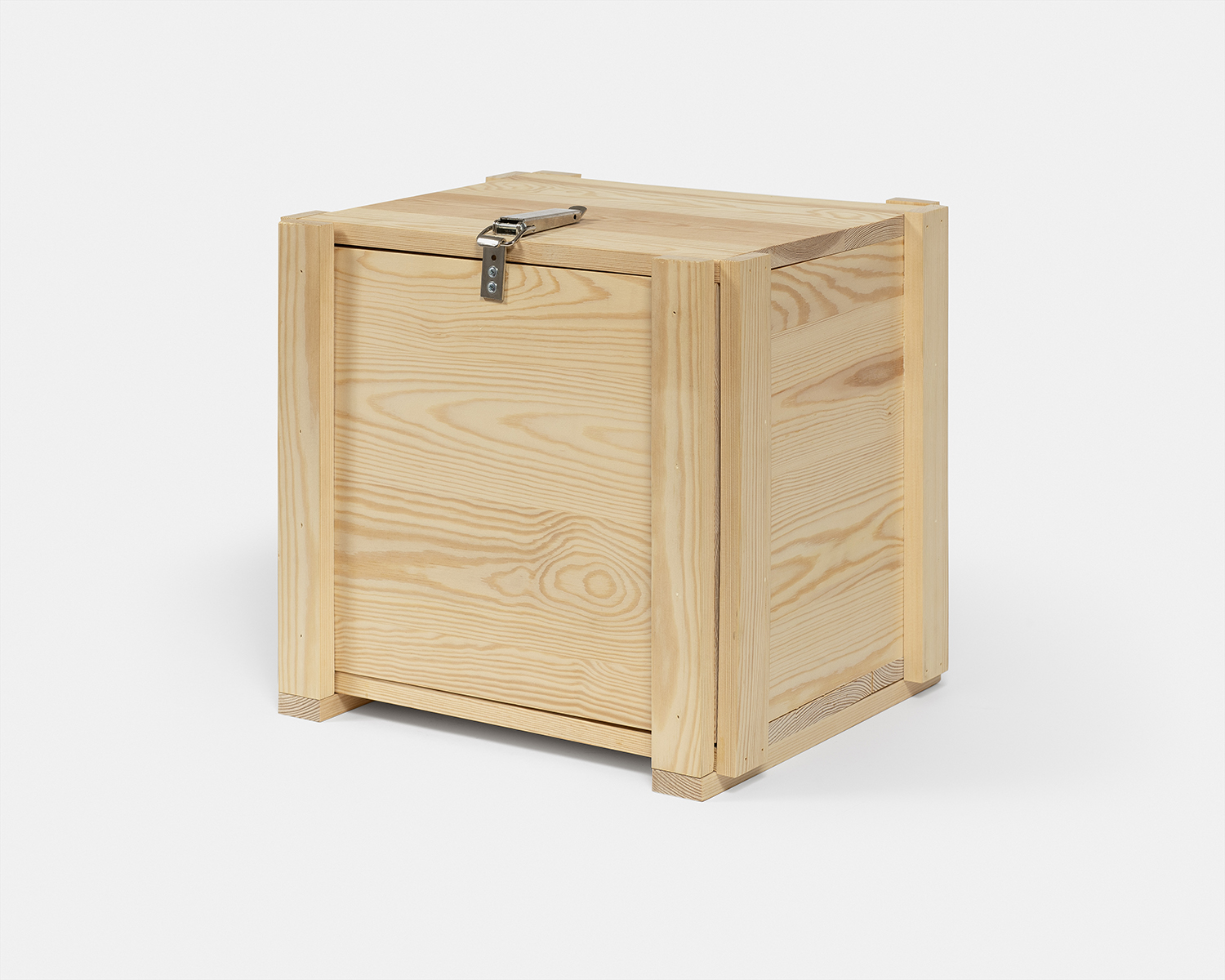
Black wooden slipcase, 57.3 x 19.2 x 25.8 cm
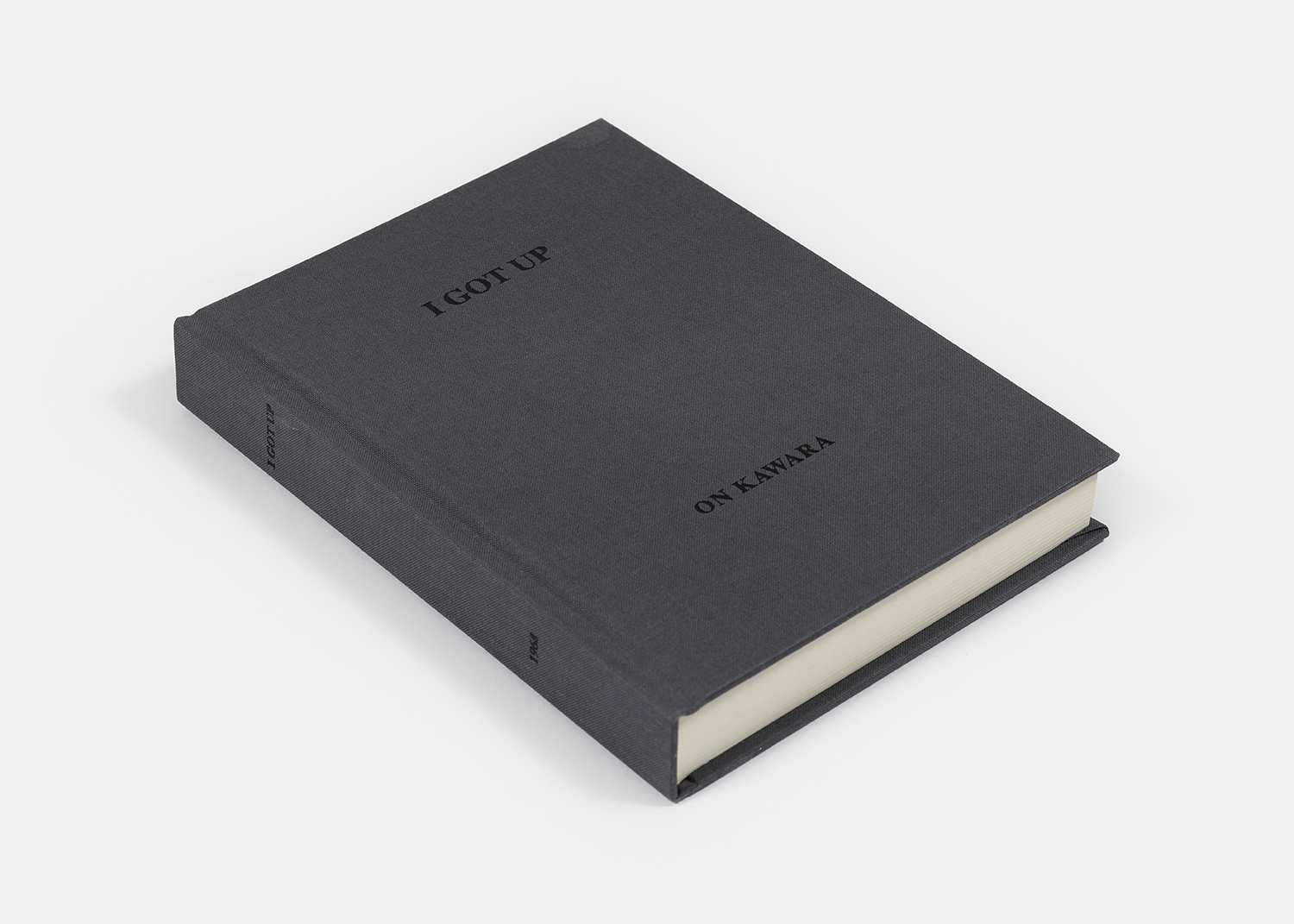
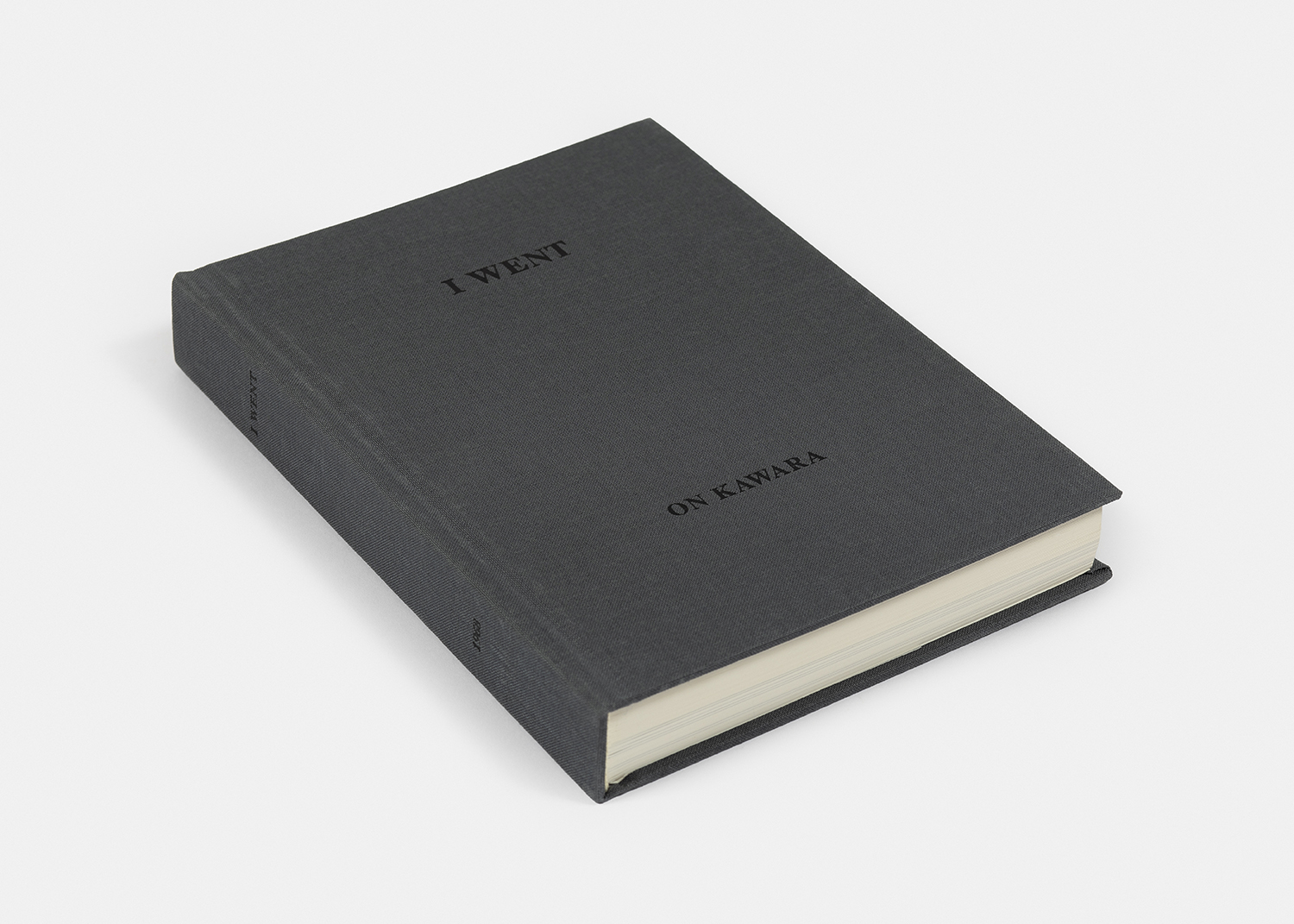
Contains 12 volumes, each 21 cm x 14.8 cm
4790 pages in total
Printed on Phoenix Motion Xantur 150g
Signatures are double-stitched with linen thread.
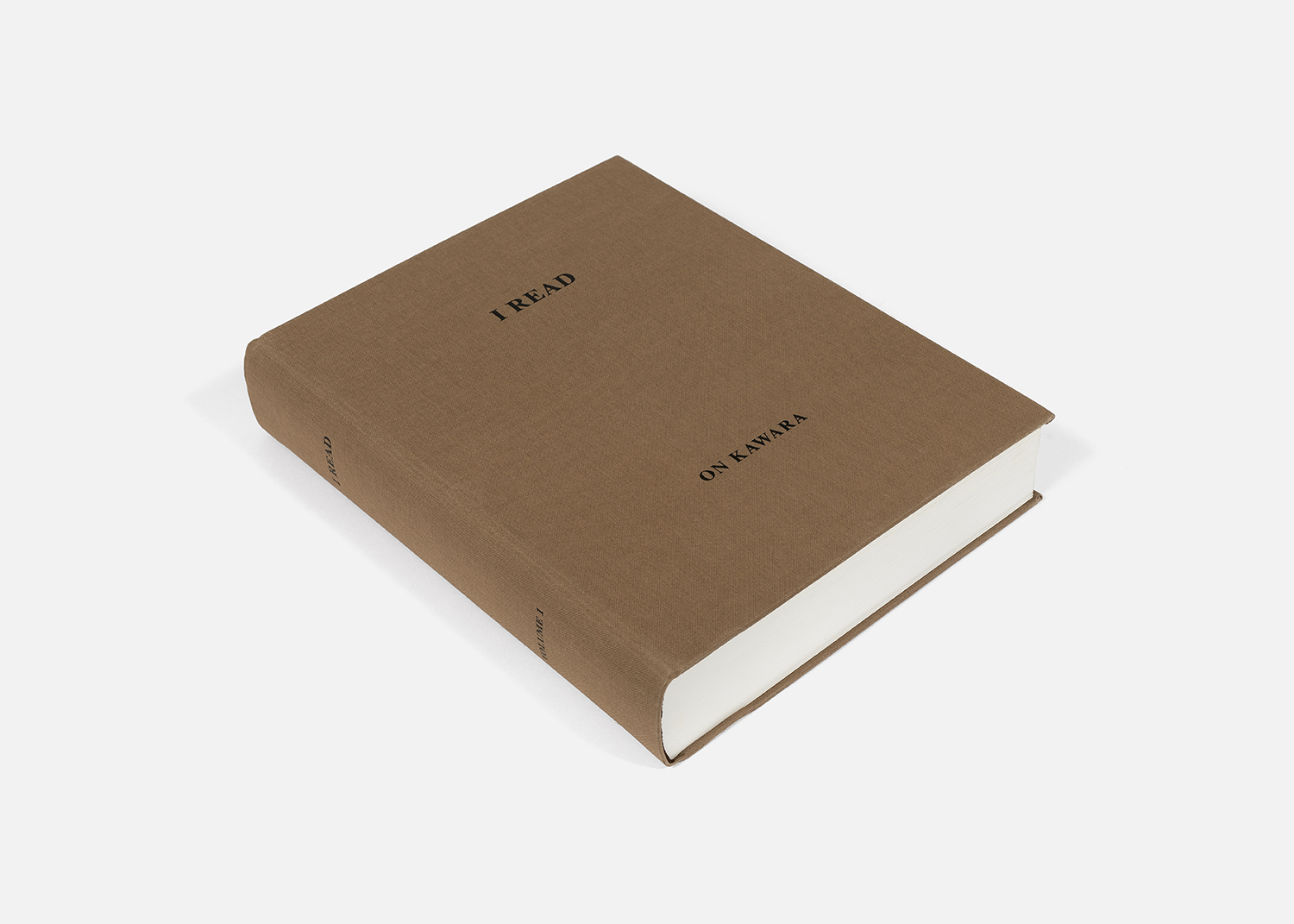
Cover bound in Brillianta Calandré Linen
Front cover and spine: embossed gilding and foil-blocking in black
Ivory-coloured headband
Printed by Arte-Print
Bound by SVK
Production
Edition of 90 numbered and signed copies and 10 artist's proofs
1968-79/2004
Produced and published by Éditions Micheline Szwajcer & Michèle Didier in 2004
©2004 On Kawara and Éditions Micheline Szwajcer & Michèle Didier
NB: All rights reserved. No part of this edition may be reproduced in any form or by any means without written permission of the artist and the publisher.
Collections (selection):
CNAP, Centre national des arts plastiques, Paris
MAMCO, Genève
MMK - Museum für Moderne Kunst, Frankfurt am Main
Van Abbemuseum, Eindhoven
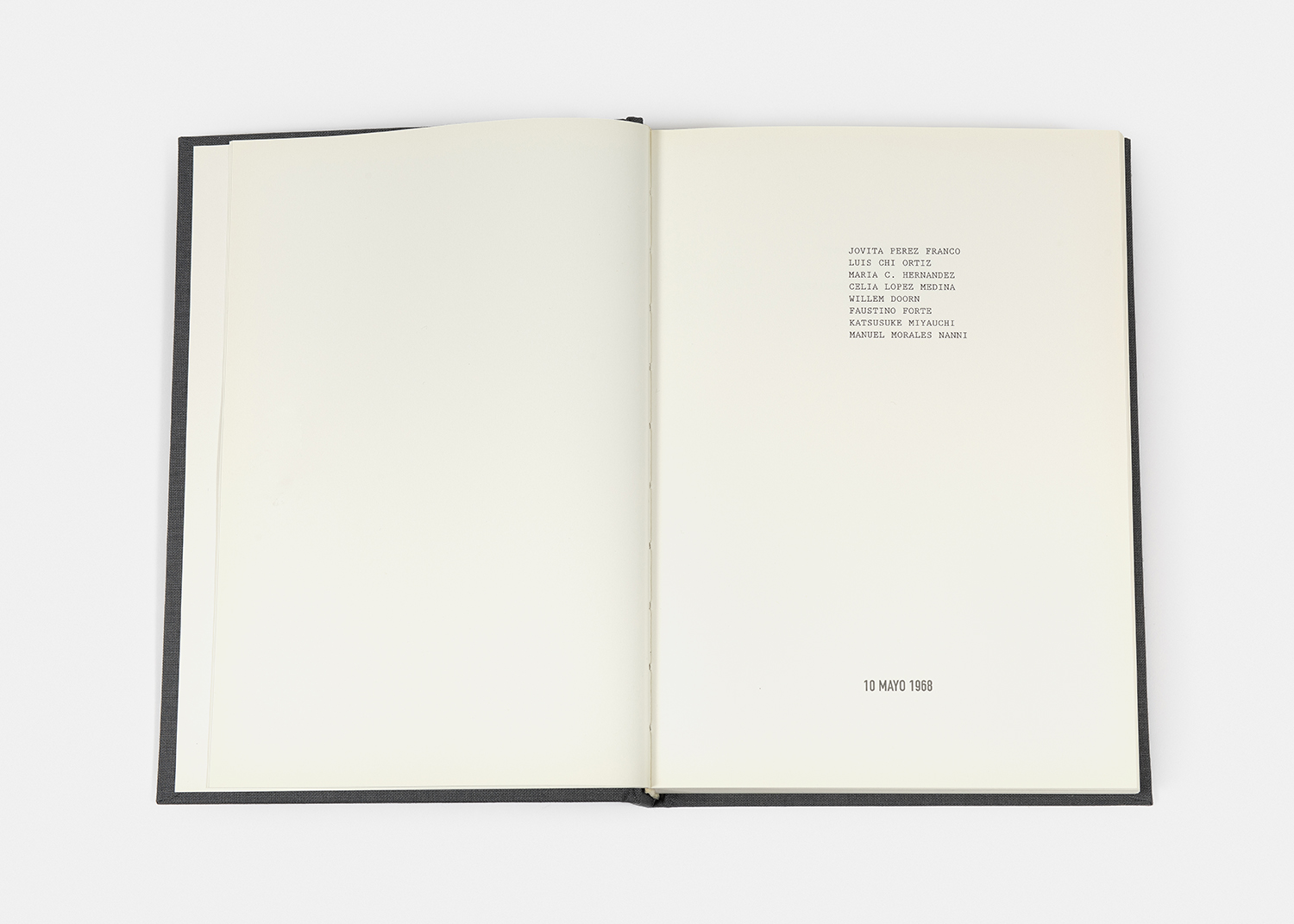
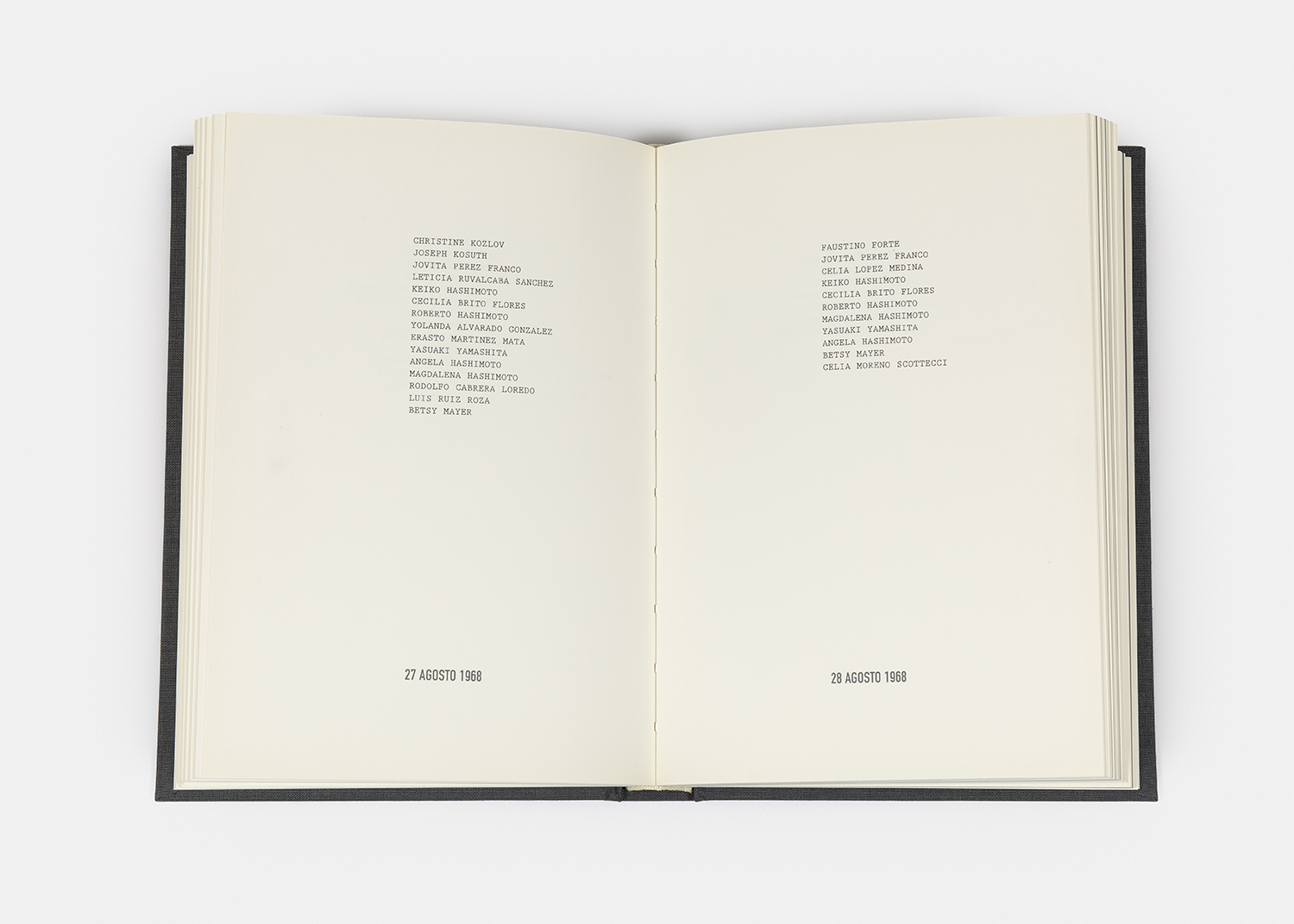
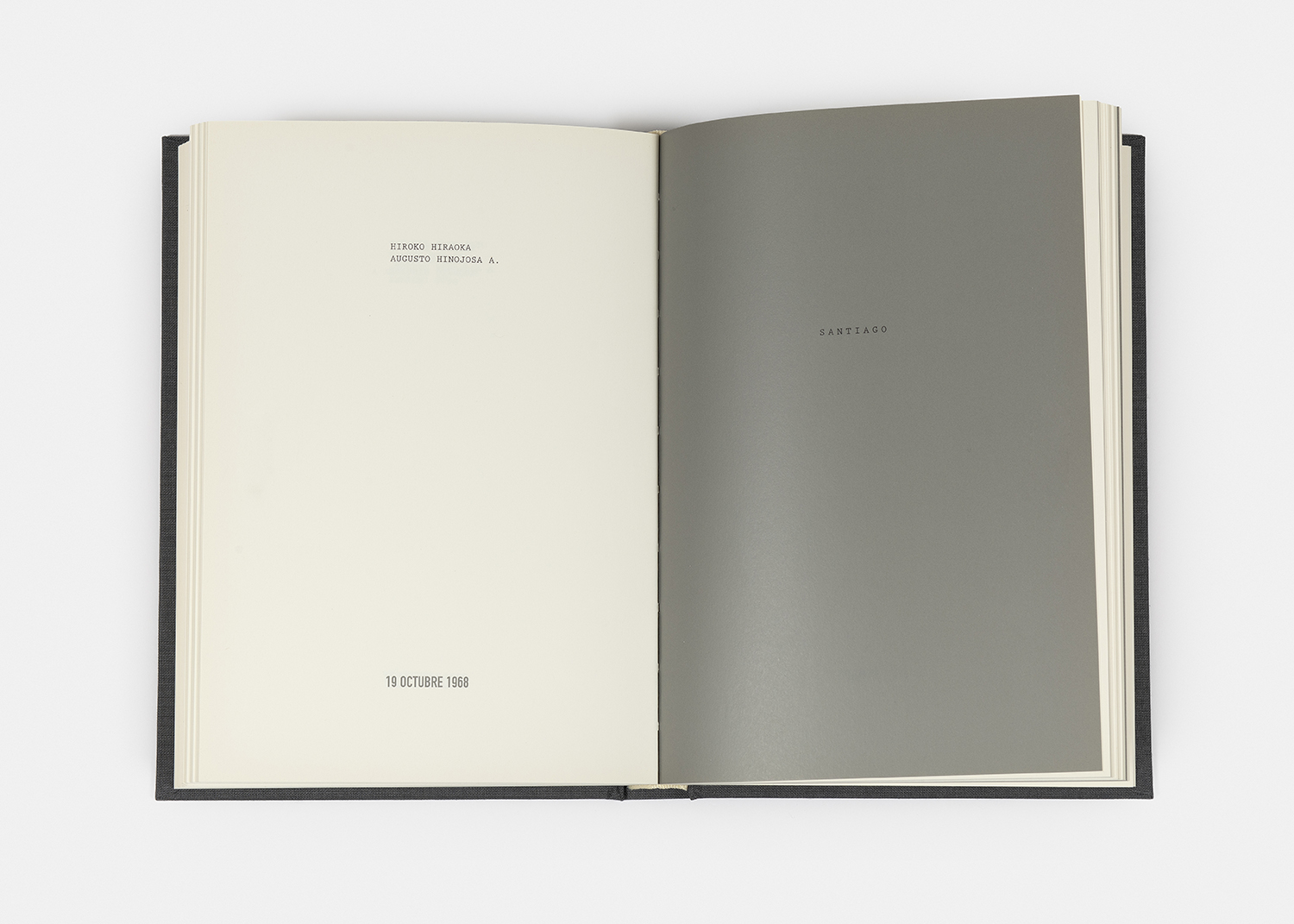
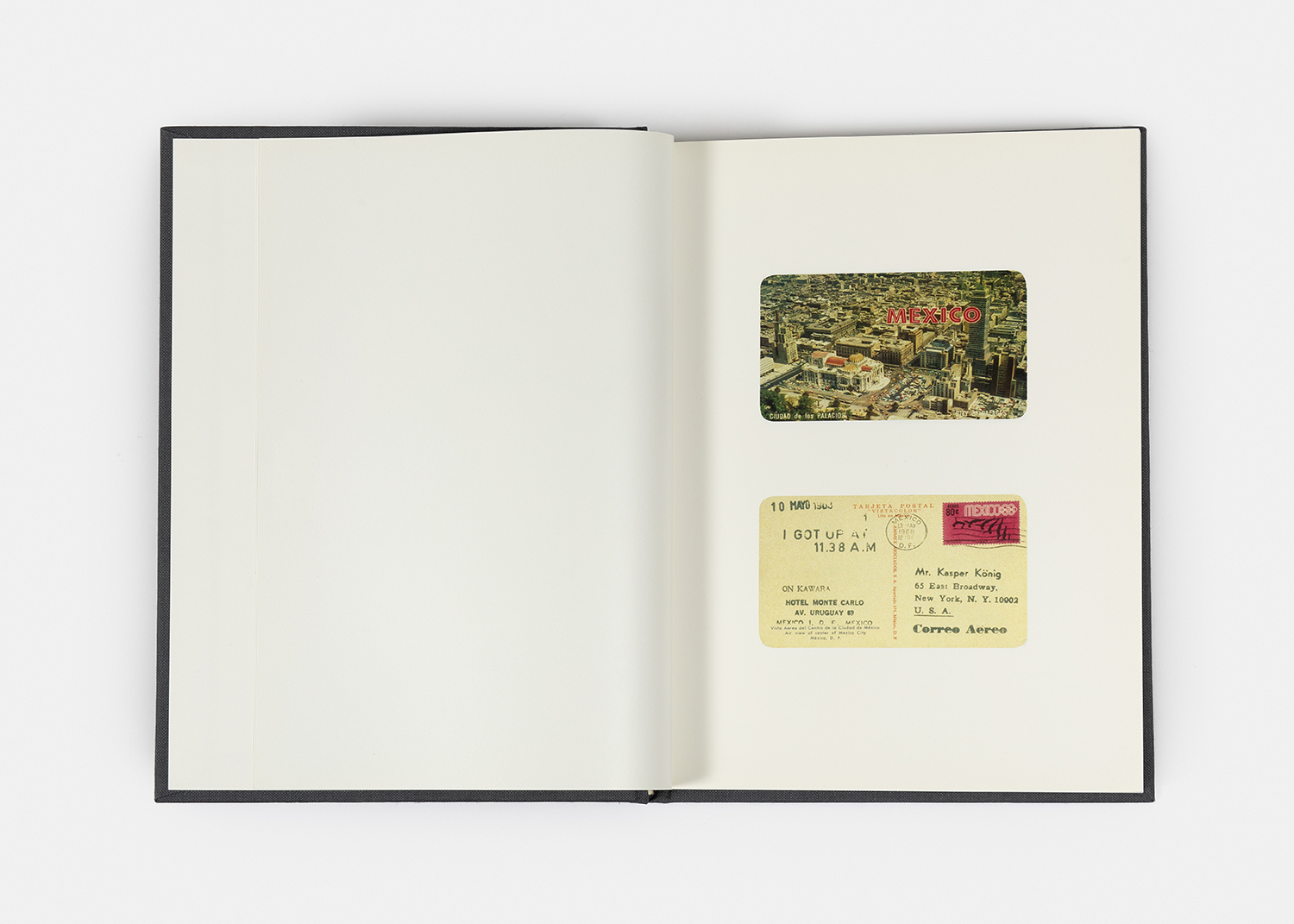
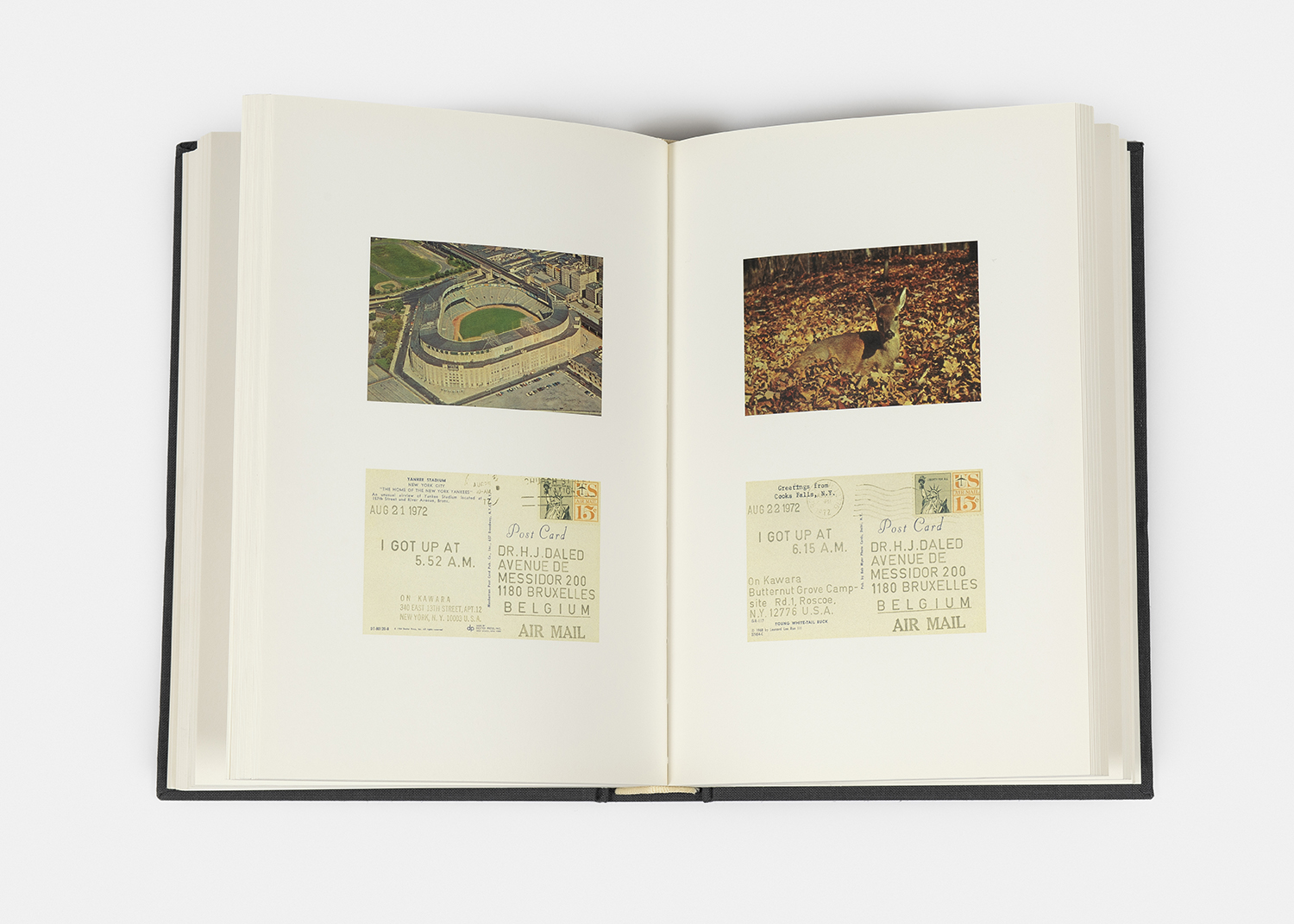
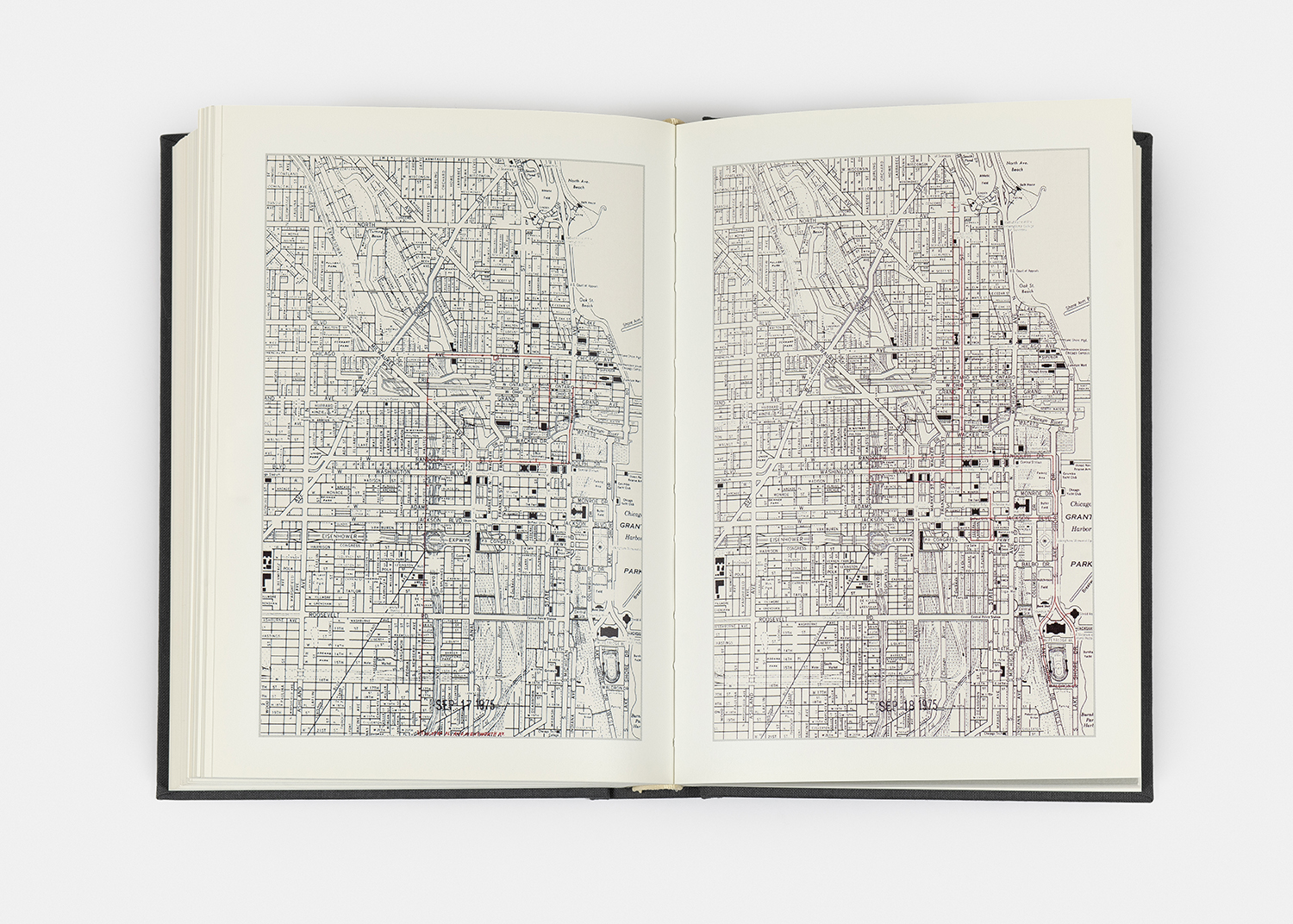
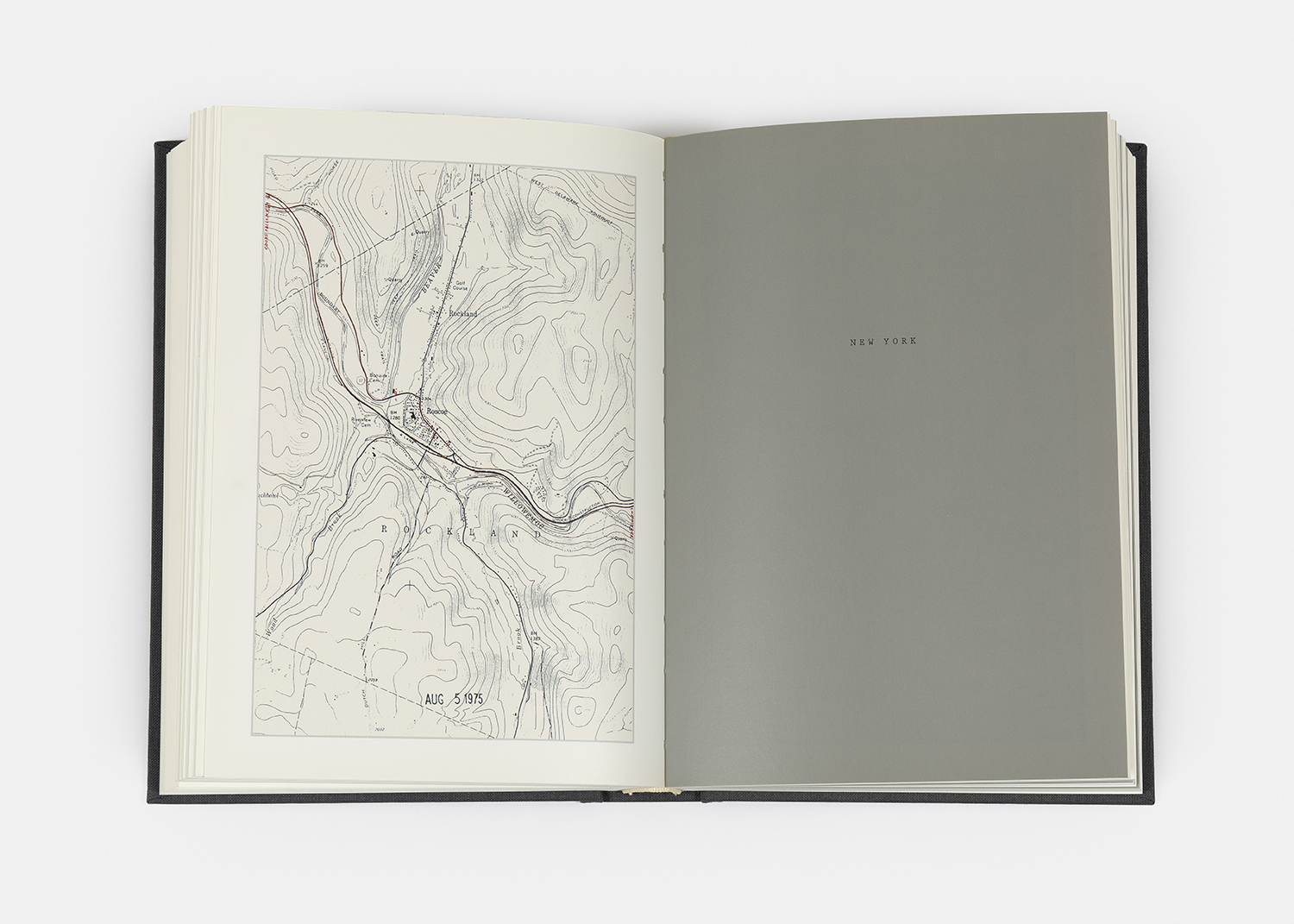
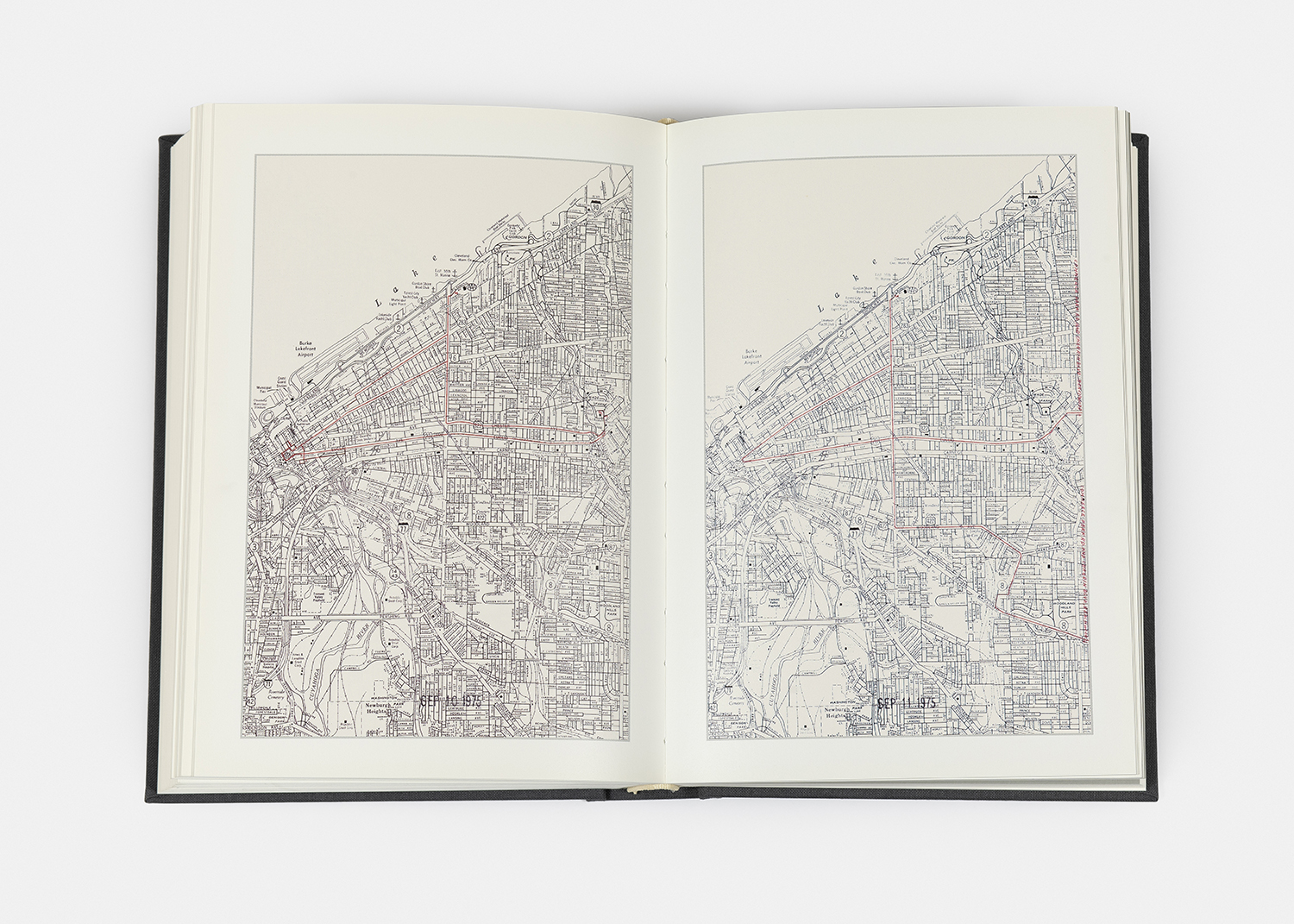
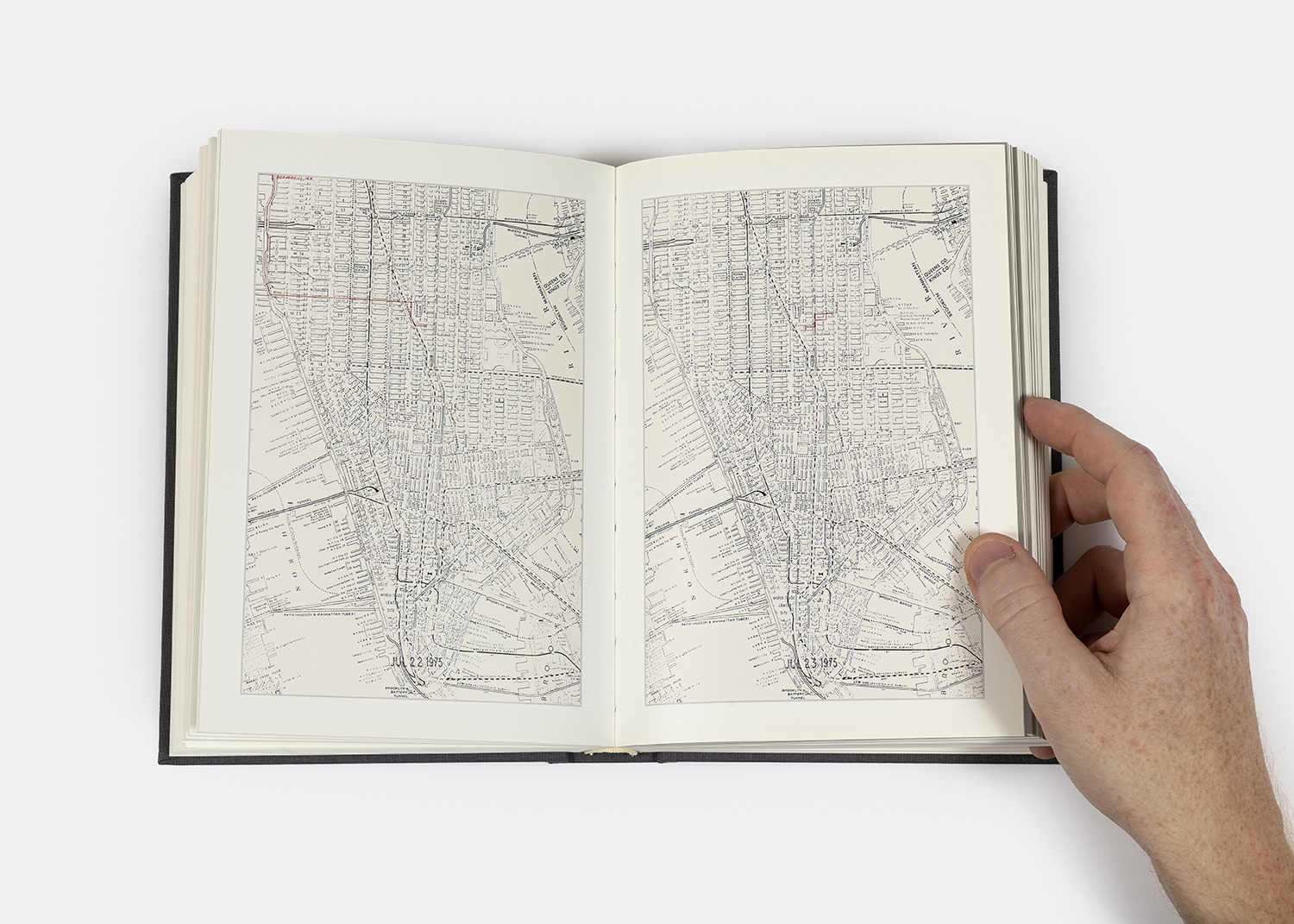
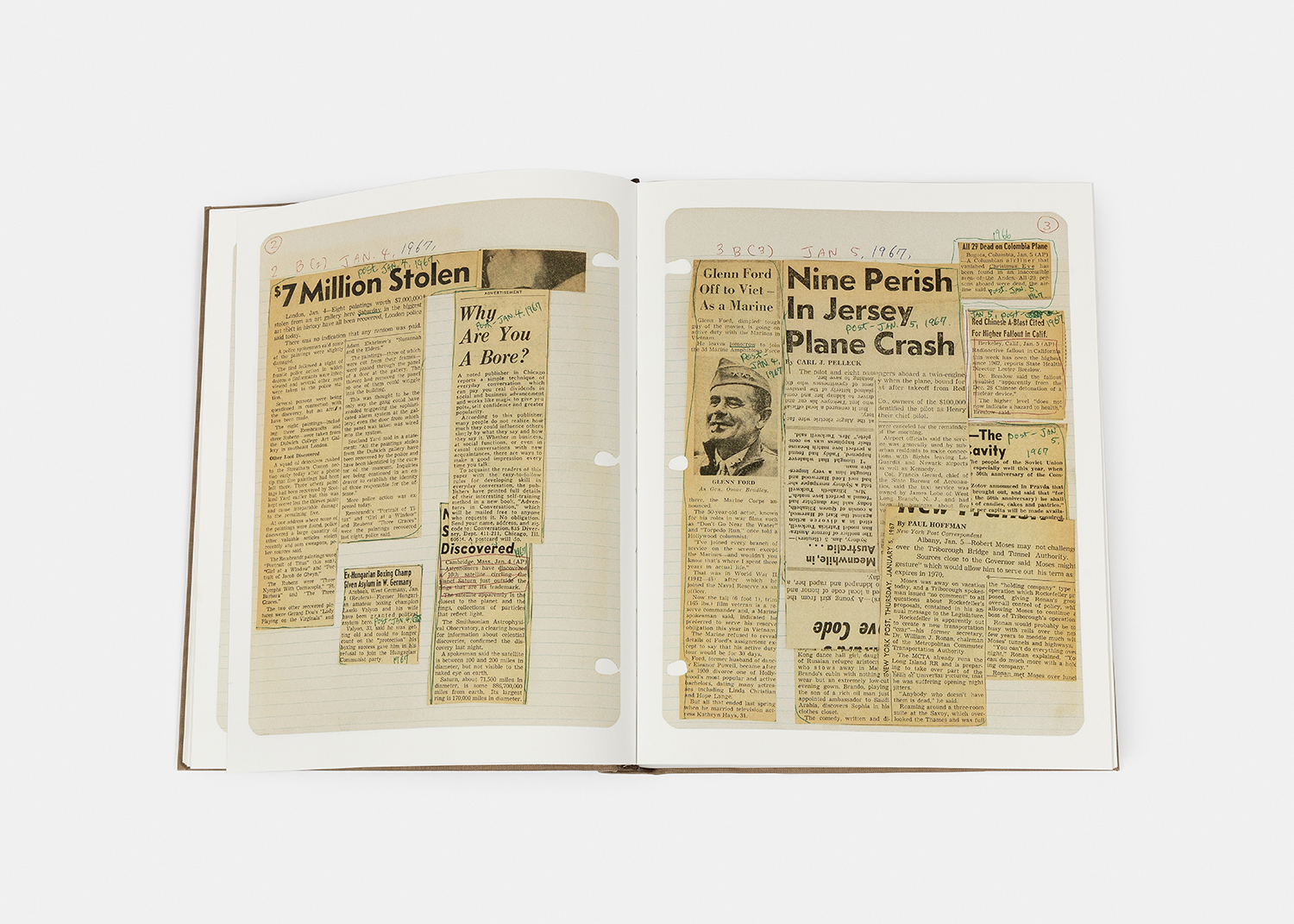
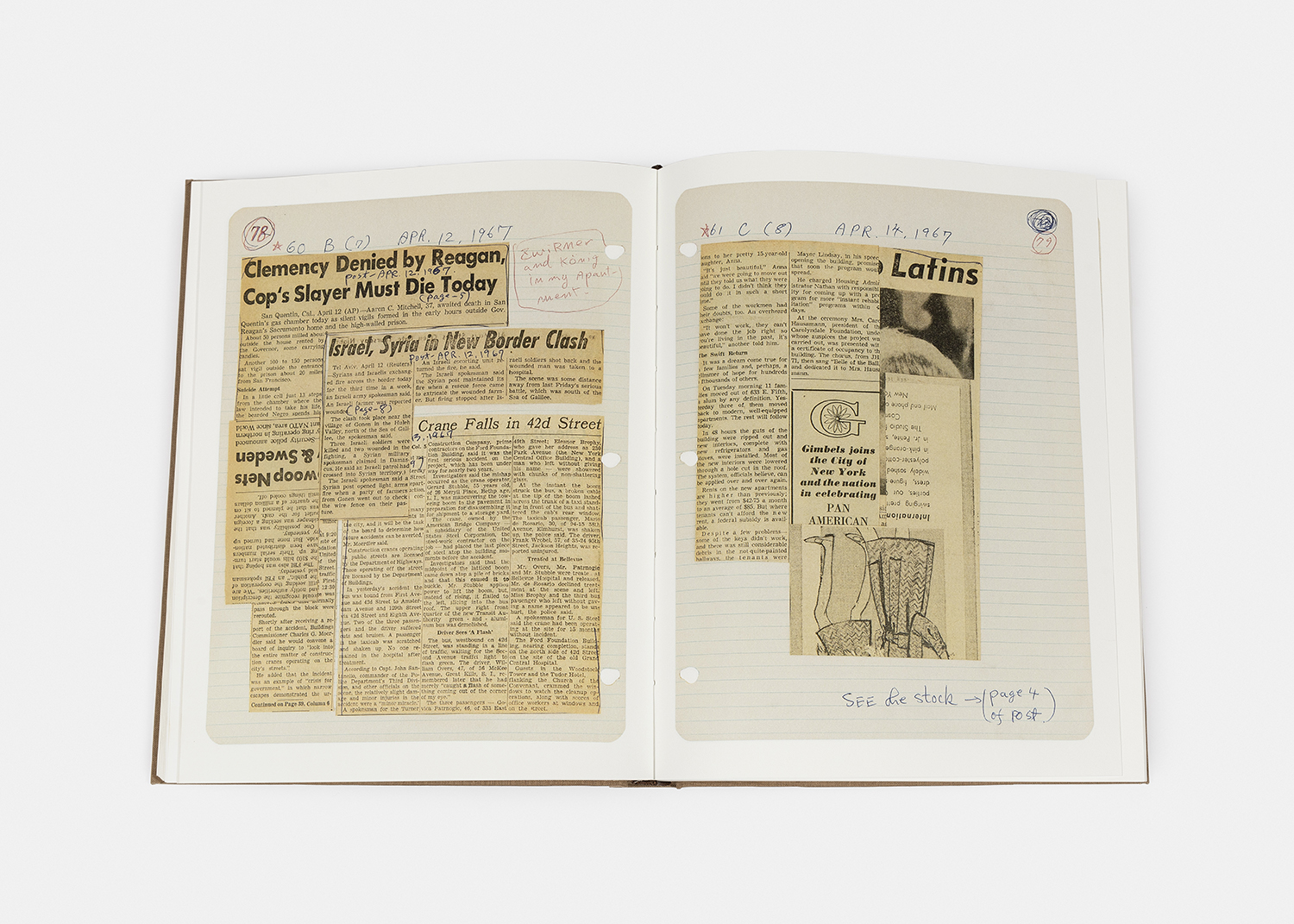
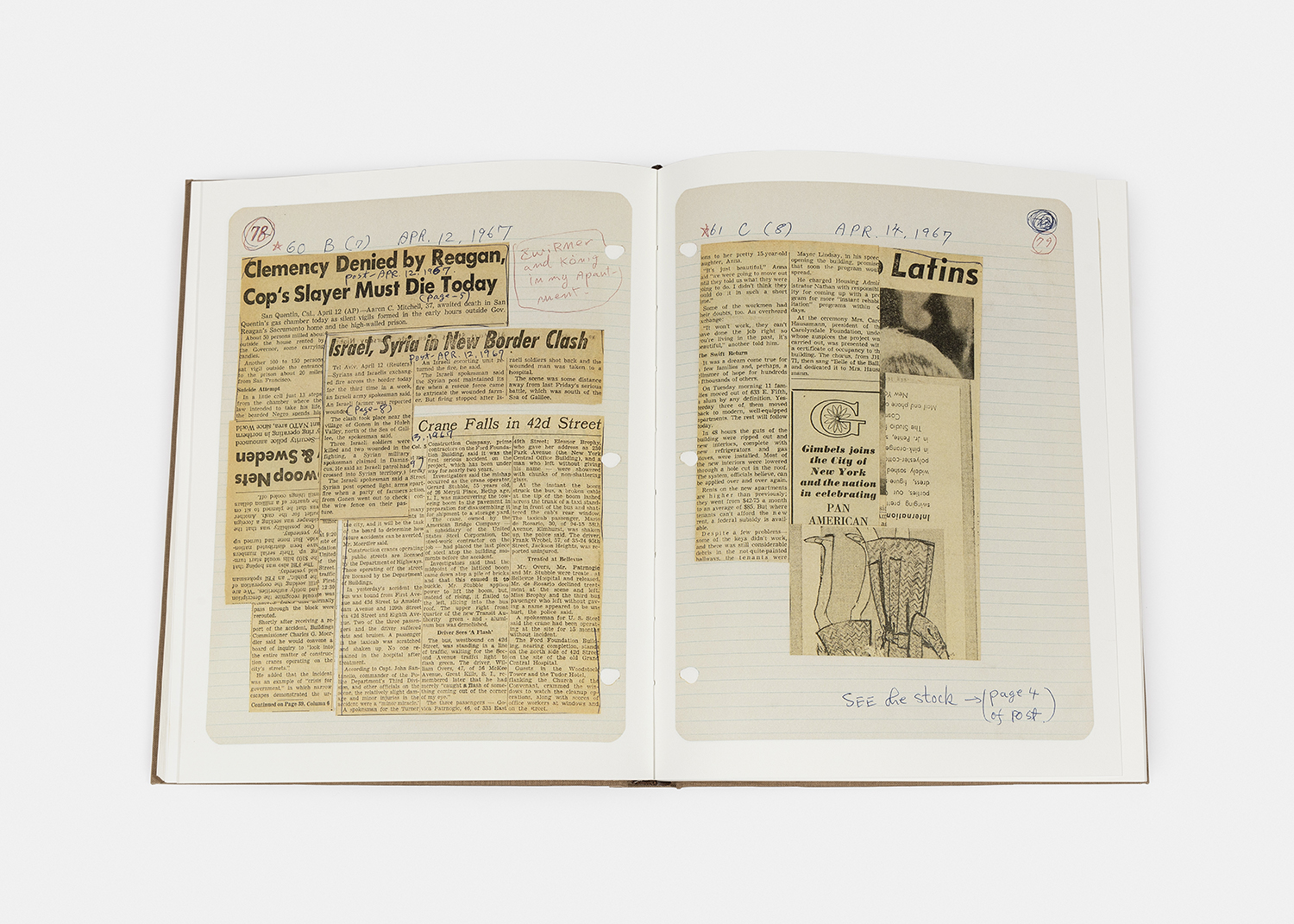
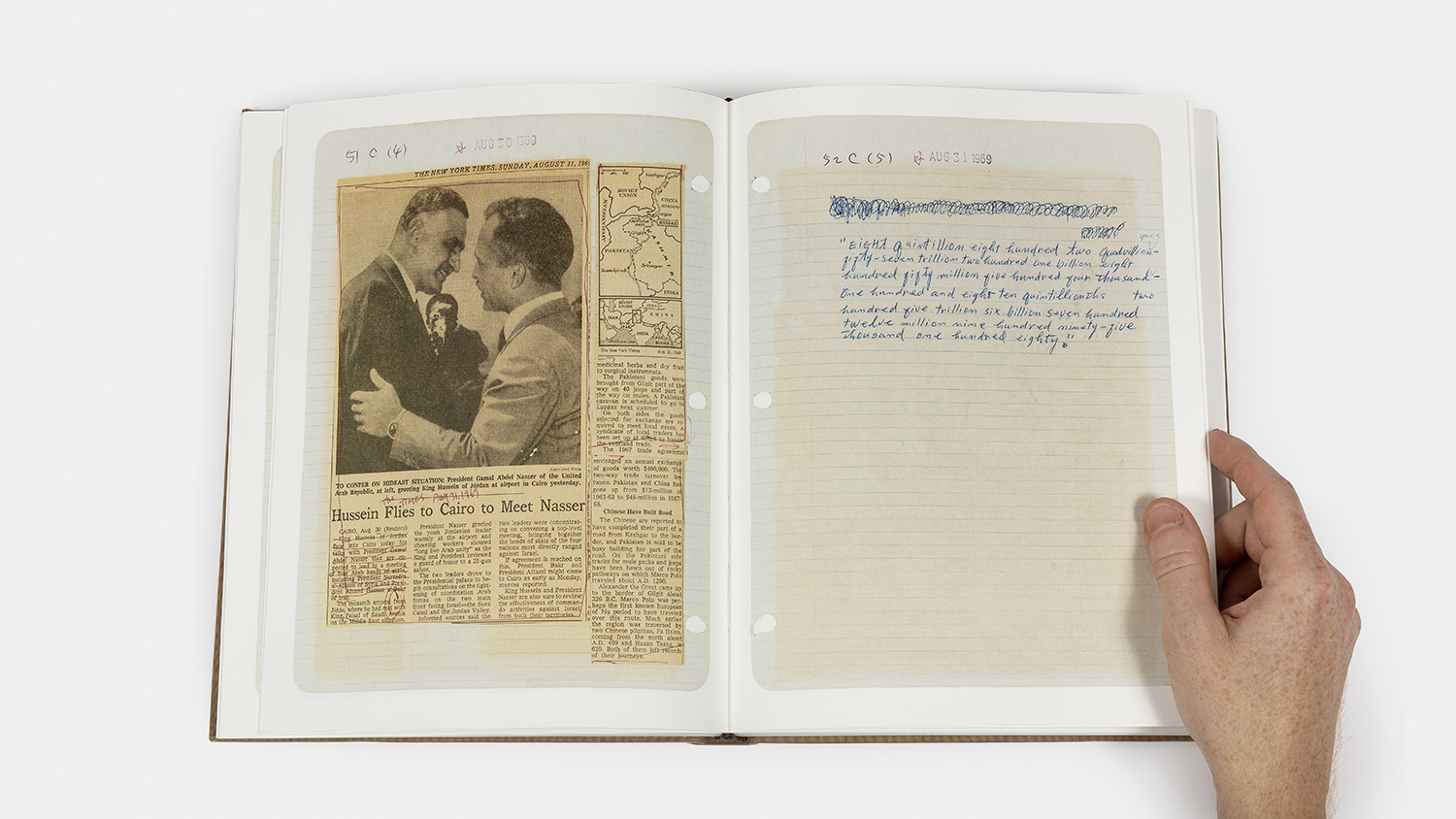
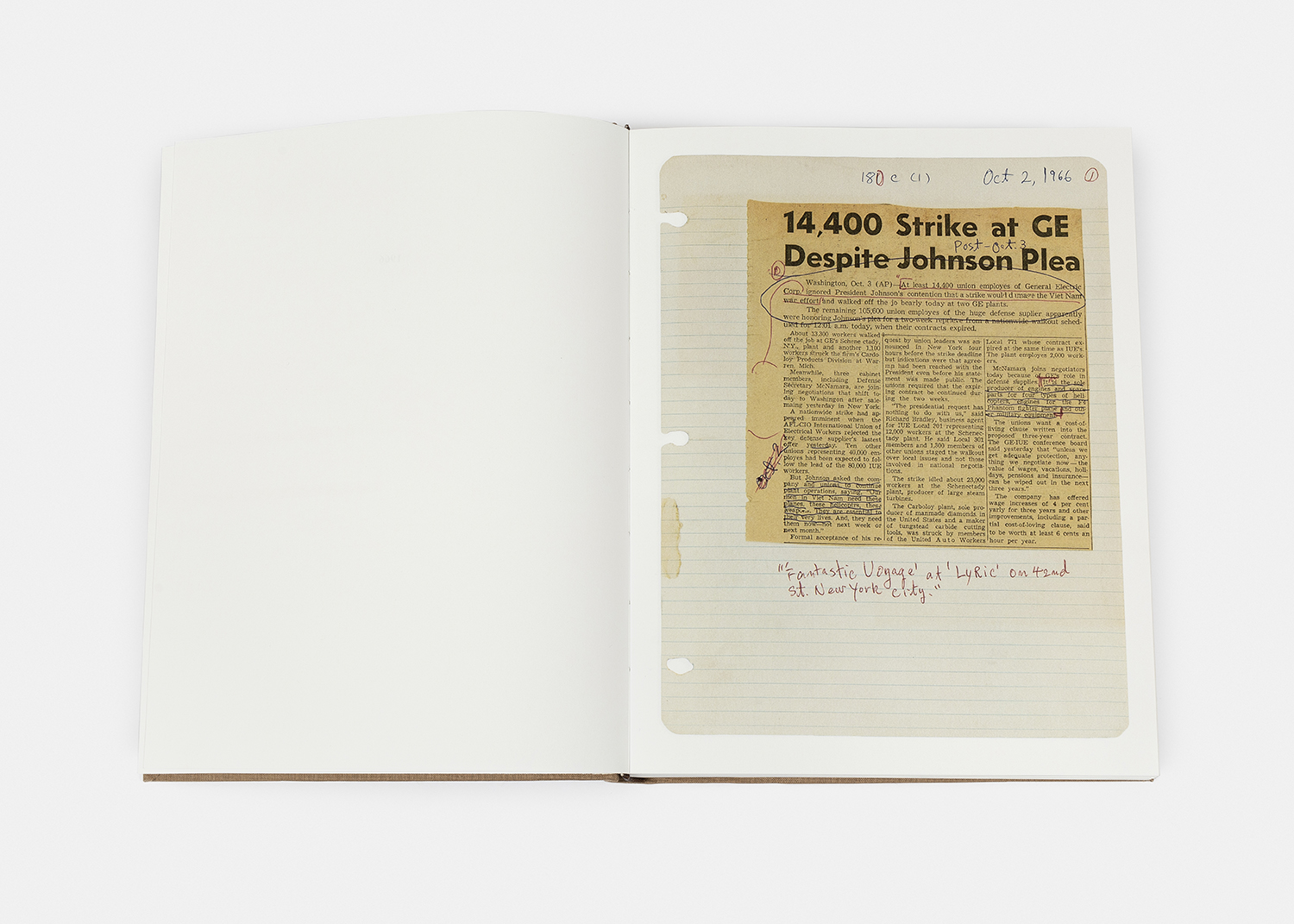
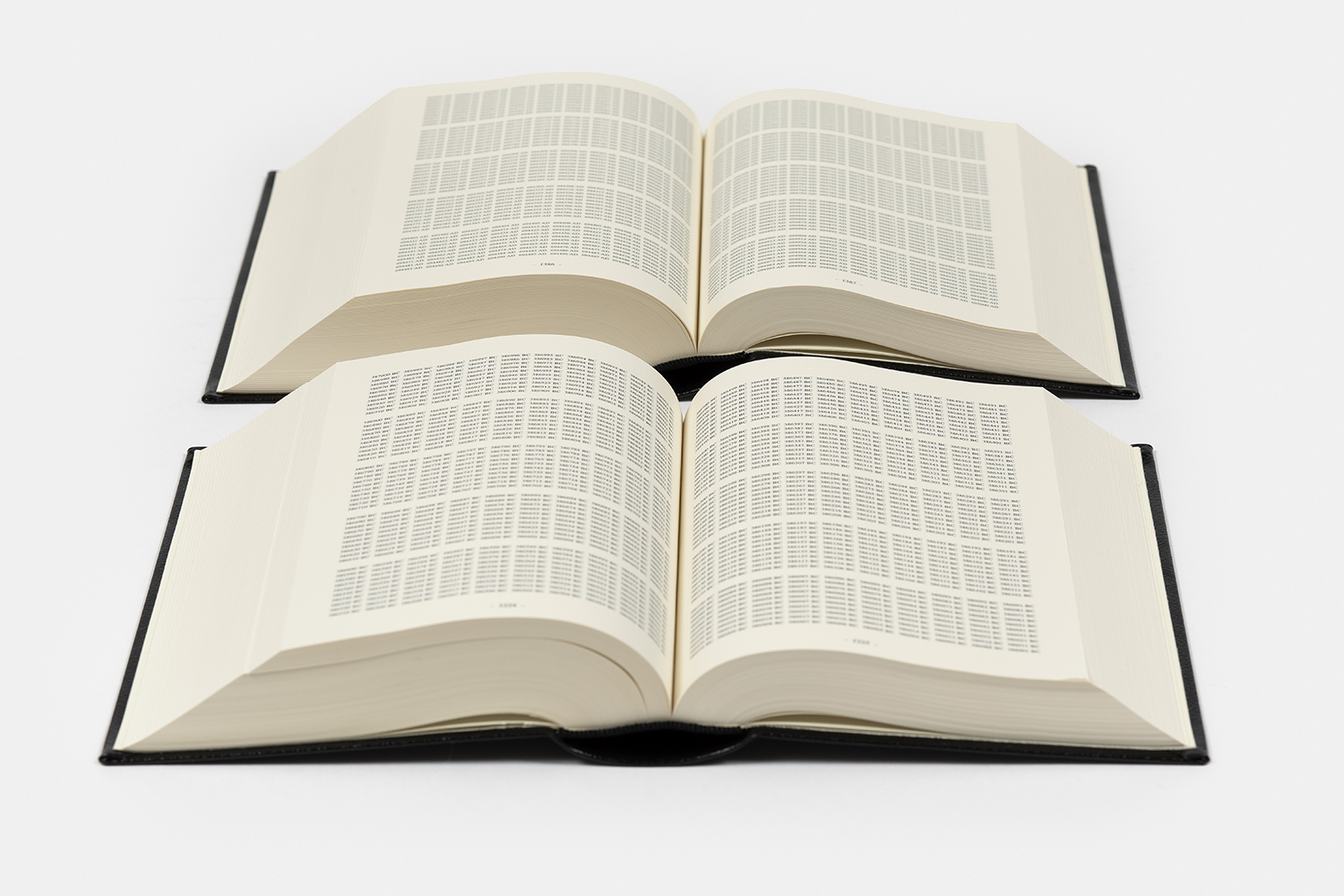
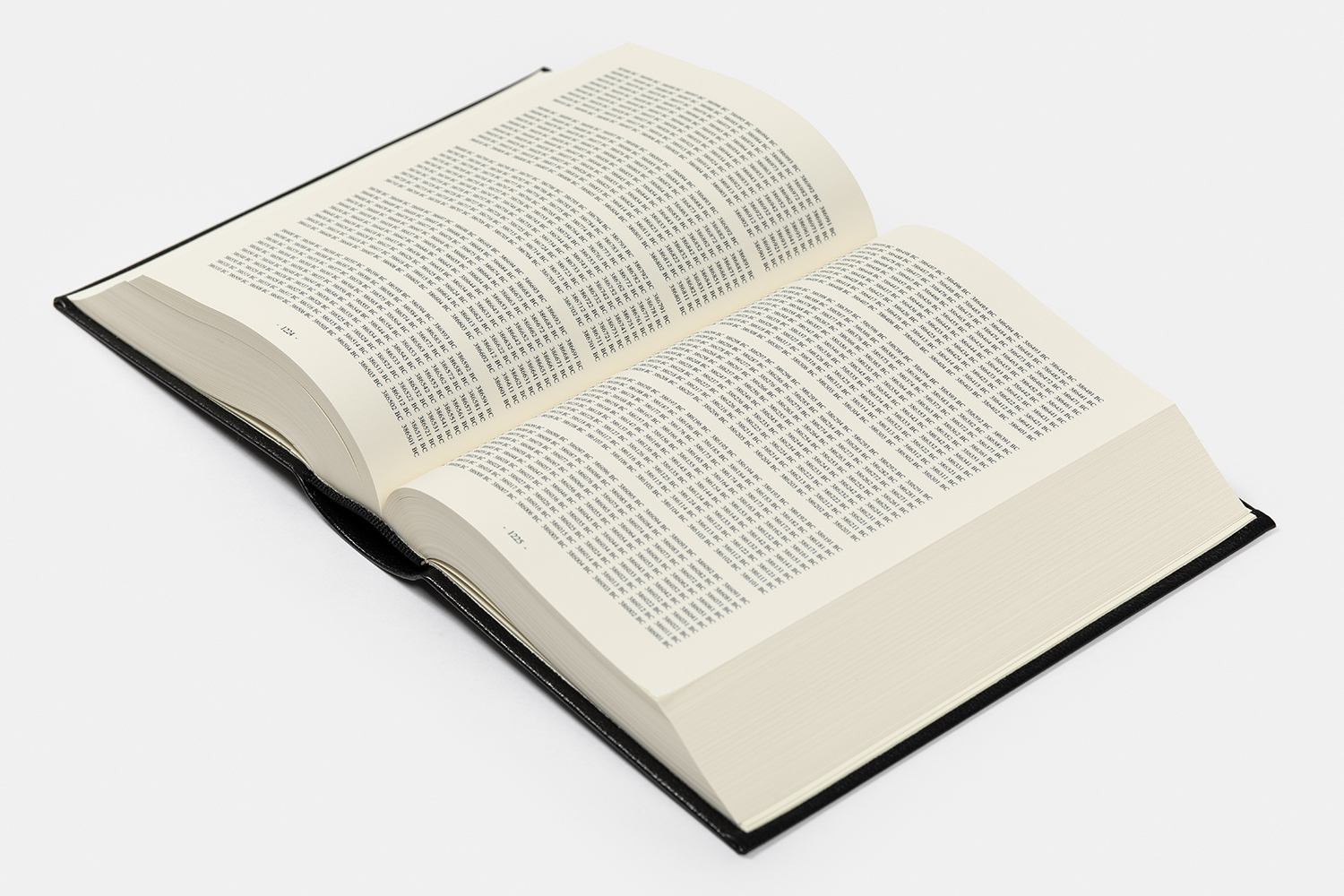
During twelve years, from May 10, 1968 to September 17, 1979, the artist noted every day the names of the people with whom he conversed in chronological order. This work was published as a twelve-volume edition. On each page, the list of names appears together with the day's stamp in the footnote. Geographical location changes are signaled by grey page dividers with the city's name. Raising fundamental questions regarding name, encounter, time or space, I MET creates a poetry of the moment by provoking the feeling that each day is like an empty page before it is transcribed in book-matter.
“What Bartlebooth would do would be neither spectacular nor heroic; it would simply be, quietly, a project—difficult, certainly, but not impossible—mastered from start to finish and which, in turn, would govern, in every detail, the life of the one who devoted himself to it.”
George Perec, Life: A User's Manual, 1978
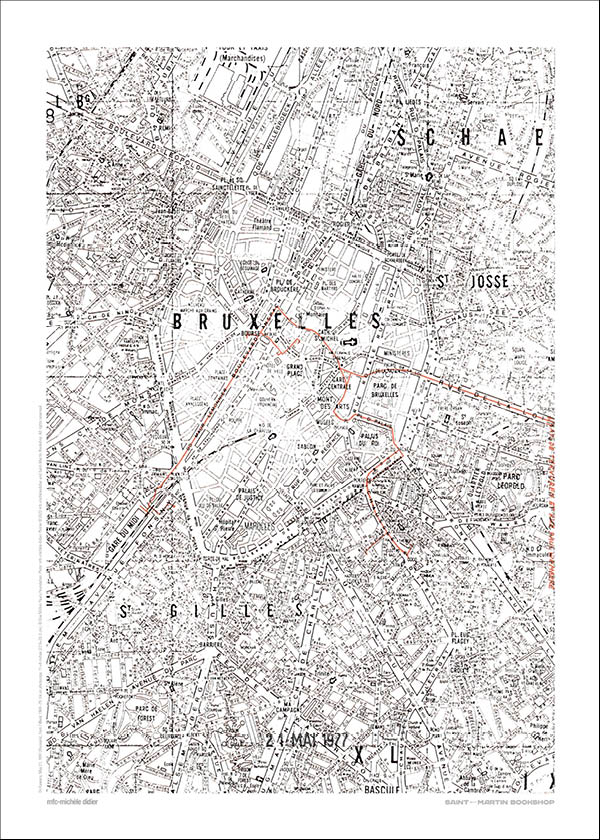
In the late 1960s, a German curator asked On Kawara, then living in Mexico, to write a poem that could be understood worldwide. A name of Hispanic origin, written on a business card, caught the artist's attention. These words struck him as an obvious poetic fact. He then began collecting the names of people he met and recording them day after day, wherever he was, whatever he was doing. All these documents were gathered and sorted chronologically into files, displayed on boards, and made visible to the public during the artist's exhibitions. This work, titled I MET, is now available in a twelve-volume edition.
I MET began on May 10, 1968, and ended on September 17, 1979. Each volume covers one year, except for 1968 and 1979. Every day, On Kawara recorded, in chronological order, the names of the people with whom he had spoken. On each page, the list of names appears alongside the date stamp. Each day of the year is presented in this manner. Over the course of these 12 years, On Kawara's travels are indicated on pages bearing the names of the cities he visited. These pages interrupt the chronology, sometimes overlapping on either side with the day preceding or following the artist's trip. The twelve volumes total 4,790 pages.
The date, written as a footnote for each list, records the number of days: the book is not numbered, but dated. Changes in geographical location are marked by gray separators. As one leaf through the book, one can imagine time on the x-axis and space on the y-axis. The “points” could be people's names. From a strictly linguistic perspective, names (proper nouns) have no meaning. In the tradition dating back to Saussure, the semantic field of the Name is empty. The name names, but does not describe. It simply isolates unique and specific entities. The link between the signifier and the signified disappears. The surname is “unanalysable.” Moreover, what characterizes the name is its privileged relationship with inscription, with the act of writing itself. In the Jewish tradition, the reading of a text bypasses the name, especially that of God. The name is not spoken; it is pure writing. The fact that a person's name cannot be translated indicates its lack of meaning from a linguistic standpoint but also its universal nature.
What, then, are the unique entities designated by each name? Even if a name belongs to several people, it applies to only one. The limits set by this arrangement raise the fundamental question of the encounter, as well as that of the connection: the connection that governs the encounter or arises from it. What conditions must be met for the artist to include a person's name and thus consider them “met”? A conversation must have taken place. But a conversation is more than a simple exchange of words. Must it be relevant, interesting, or original? Indeed, do we even have everyday conversations worthy of such a name with our life partner? It is quite possible that some of the protagonists of I MET were included simply because of their presence, while others had to exert more effort to be included in the list.
Are they really lists after all? Perhaps not, for each item in the enumeration carries varying intensity and evokes a different kind of connection each time. Although they are neatly aligned in a column, they each claim their own territory with distinct contours, representing a complex and intimate landscape. The repetitive phenomenon can serve as a clue to unraveling the enigma. Since the columns of Names are marked daily by the presence of Hiroko Hiraoka's name, the recurrence and order of appearance grant her a very special, one-of-a-kind place as the artist's life partner. It is very clear that an iconic artist like On Kawara, engaging in such an activity for twelve years, will ultimately compile a detailed account of the conceptual art scene on an international scale. But let us not forget that the result of what appears to be a systematic, repetitive, and rigorously determined undertaking is in fact a more or less random capture of moments—those of the days that pass in a life. Indeed, while certain lists might lead us to believe that ALL the well-known figures in the art world consciously scheduled appointments for this or that day, the story can only be “told” retrospectively, once the necessary scientific time has passed to allow individual objectivity to be replaced by collective subjectivity.
The same is true for a young child, aware that they will grow up and change significantly, and wondering what they will look like as an adult. A lost cause, as they will only realize when the time comes, and then they will wonder about their old age… and so on. I MET does not echo a system, but faithfully translates the flow of things, which is by nature uncertain and shimmering. We can even go further and consider I MET as an anti-system. A work that ends as it began, by chance, due to the unexpected disappearance of the notebooks in which On Kawara had collected the fruits of his collective labor. I MET has created a poetry of the moment by evoking the feeling, as one leafs through the book, that each day is like a blank page before being transcribed, in the flesh and in the book. These two operations blend completely here.
The written name functions here as an appearance. But an appearance that is renewed every time you read it, just as when we see Cary Grant on screen. We would never doubt the authenticity of his appearance just because the film dates from 1935 or because the actor is dead… On Kawara, in his own way, also develops what is known as a “suspension of disbelief.” The subject must not only be believed, but must also believe, knowing that something else could have taken its place. For example, we must not forget that the appearance of Cary Grant, and not Clark Gable, in a film is the result of a chain of circumstances chosen entirely by chance and long since forgotten. The names are these and not others, although “the others” could have been “these.” The value stems precisely from this ontological fragility.
When the question of time is raised, a reflex immediately brings to mind our mortal condition. But with I MET, On Kawara has found a magical way to circumvent this by powerfully embodying the idea that time is, above all, a human construct. Death is a familiar subject for the artist, as he witnessed the impact of nuclear weapons. If the experience of total annihilation is the starting point, the passage of time—which normally runs from birth to death—will follow the path in reverse. The pioneer of atomic science was the first to develop the theory of relativity, which shook an entire generation, to which Kawara belongs. The question of how to use such discoveries quickly arose, and humanity has been unable to resolve it ever since. On Kawara, the artist, knows how to confront these questions.
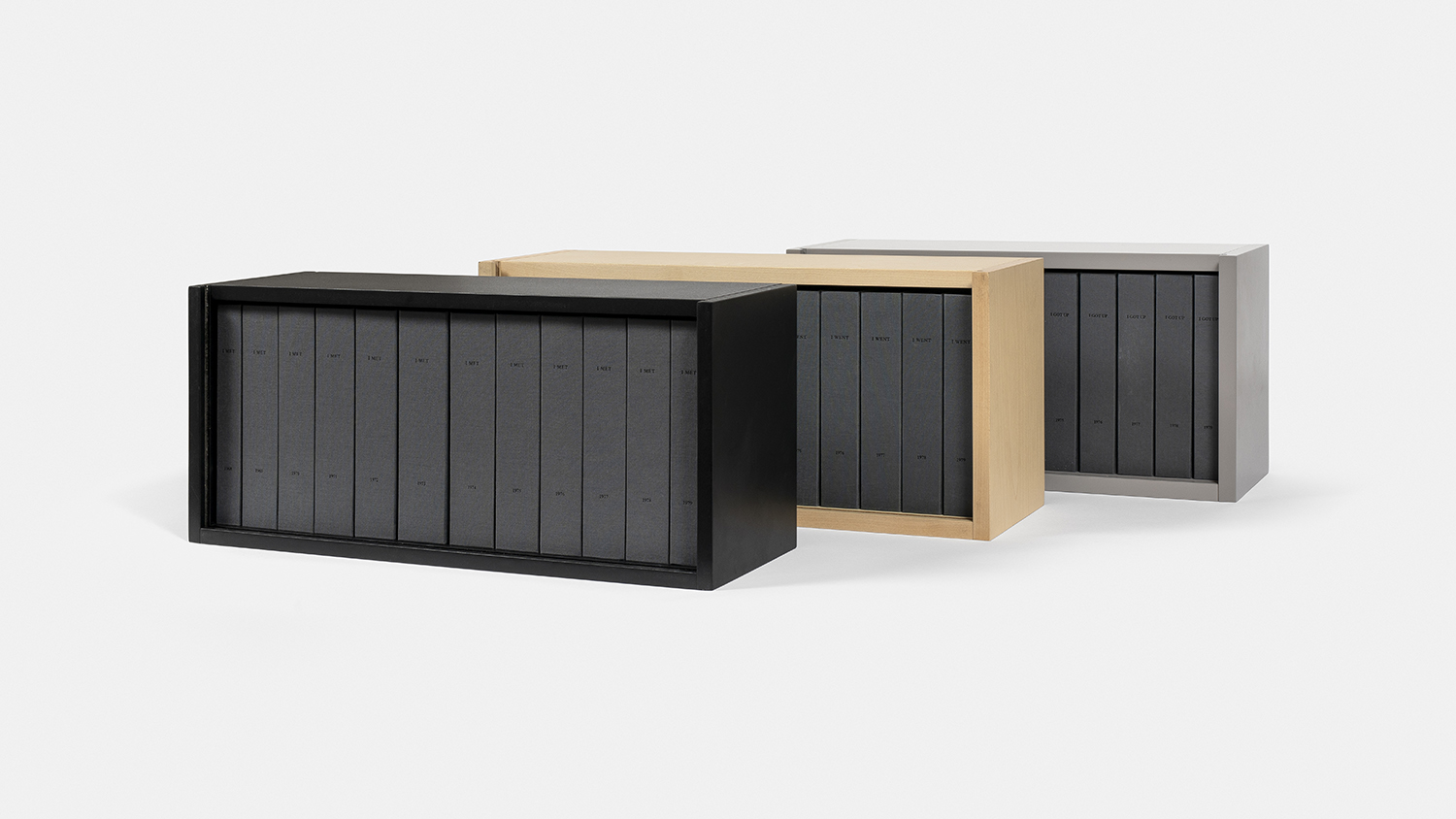
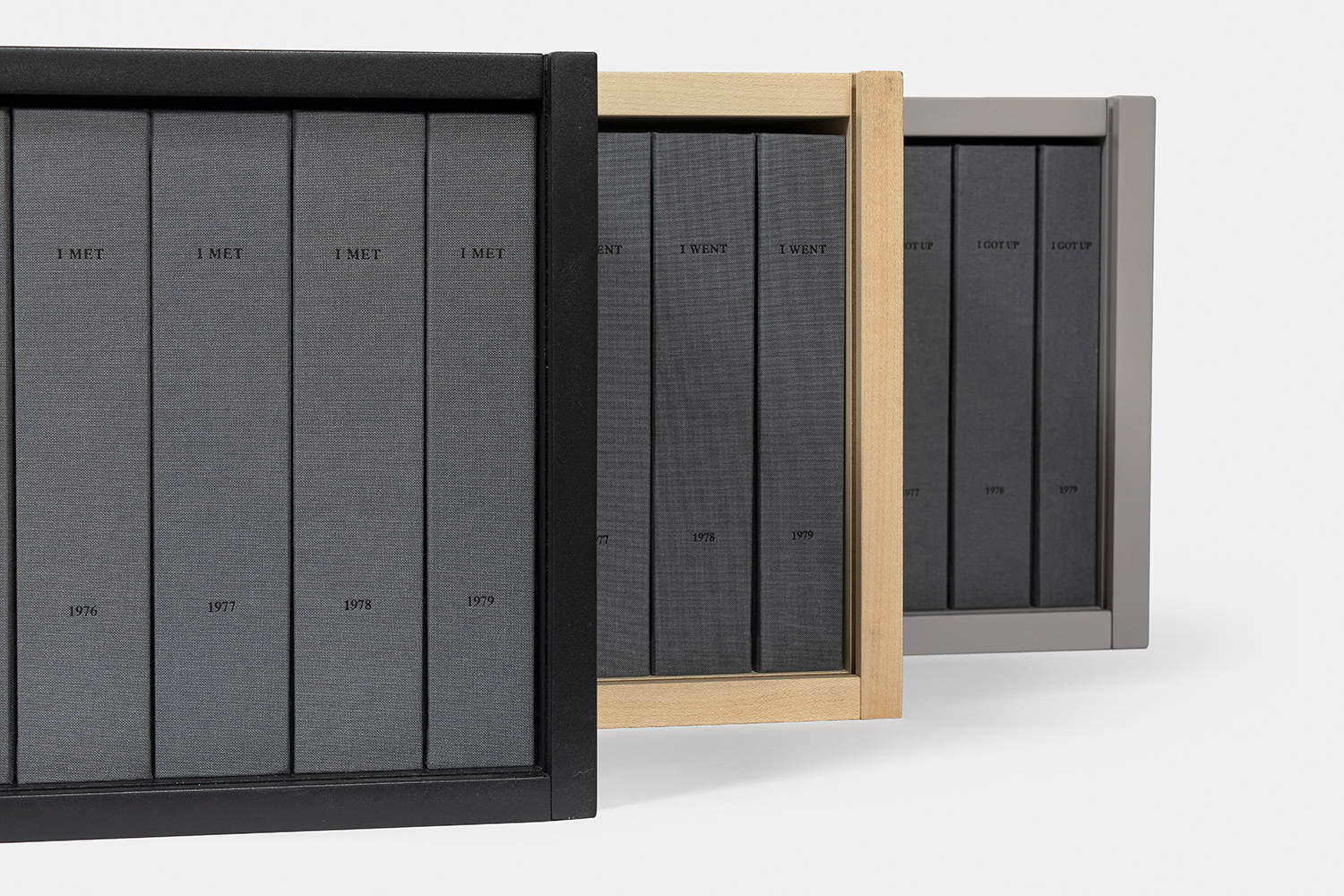
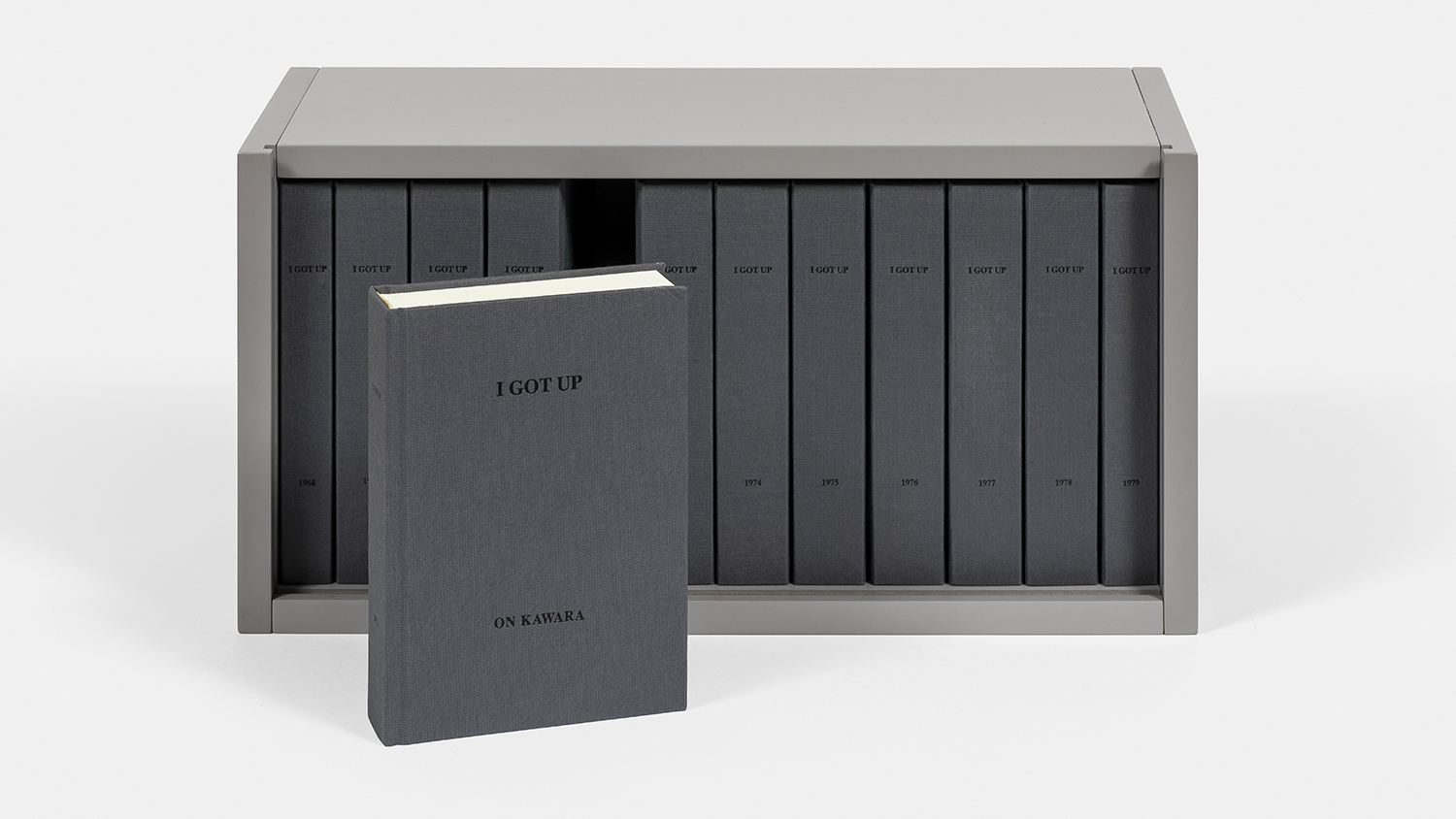
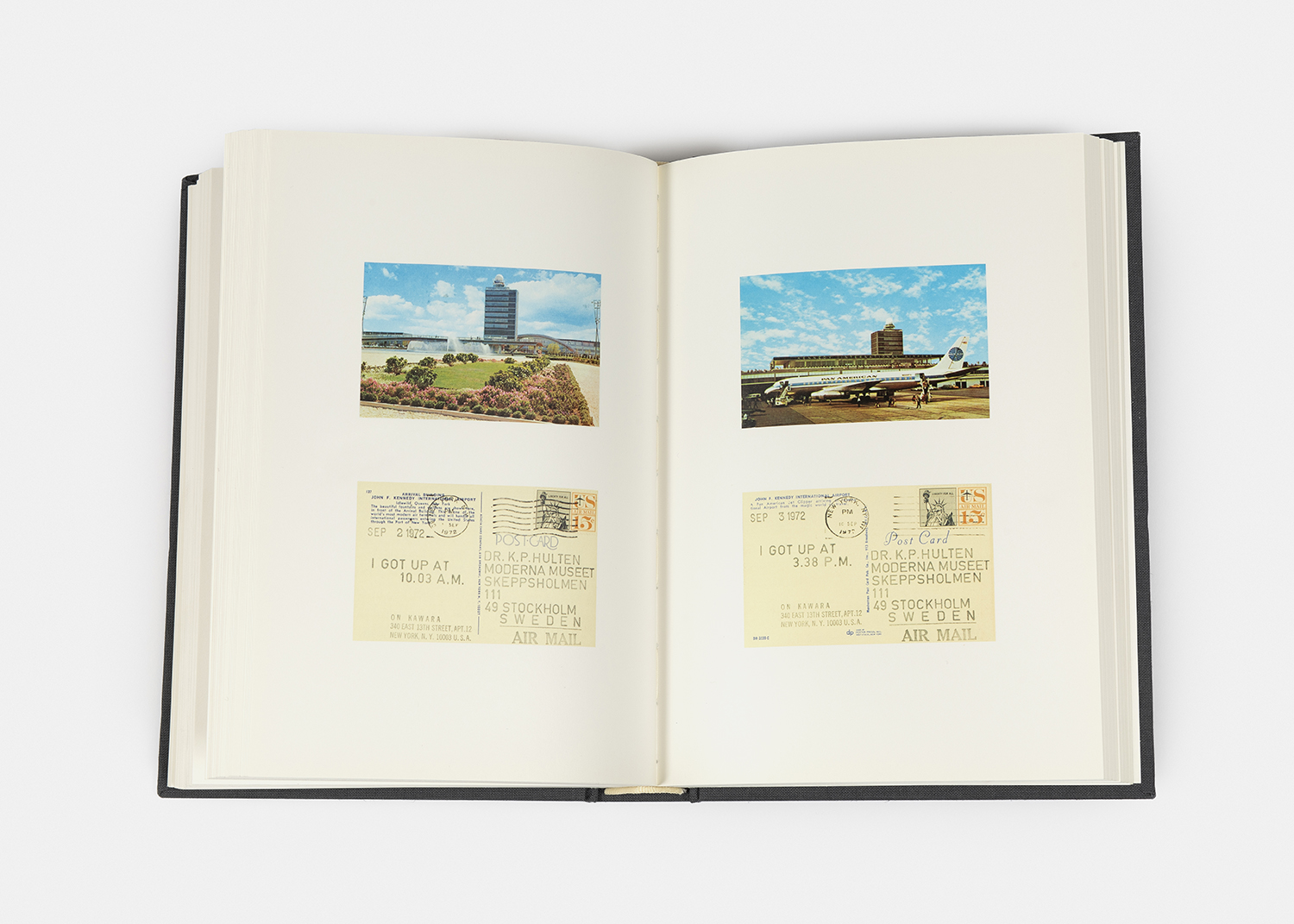
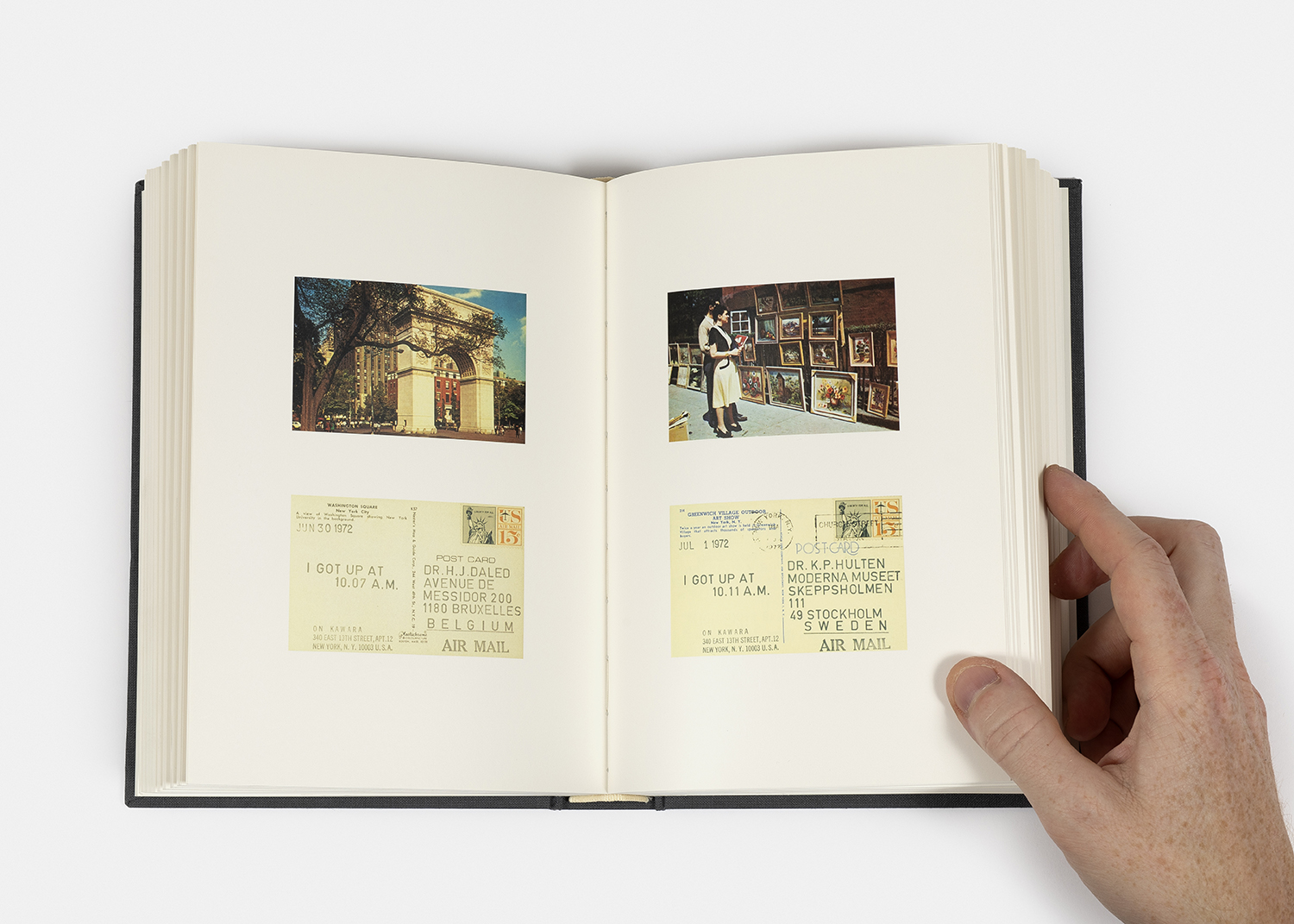
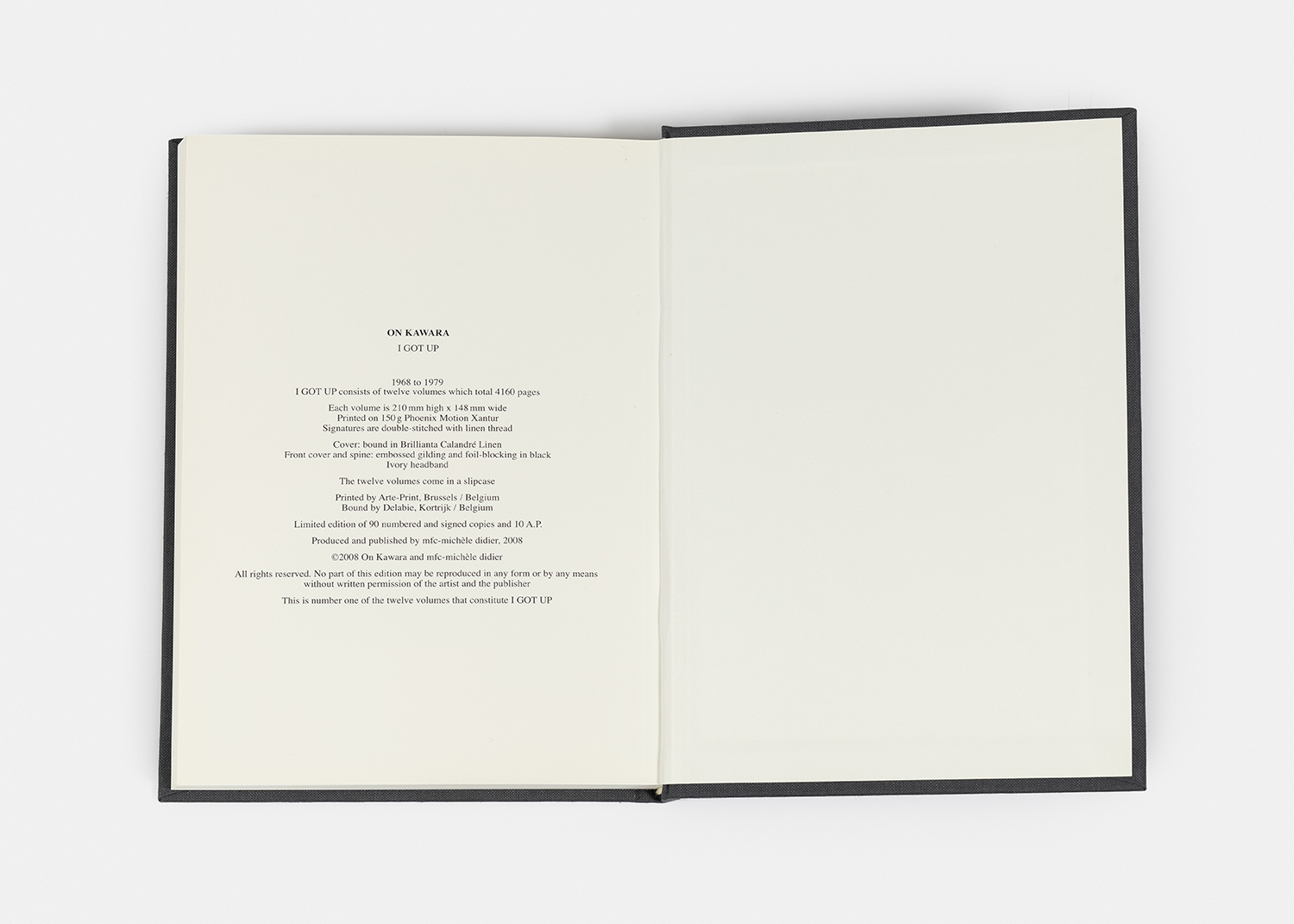
20.08 x 7.48 x 9.84 in ( 51,2 x 19,2 x 25,8 cm )
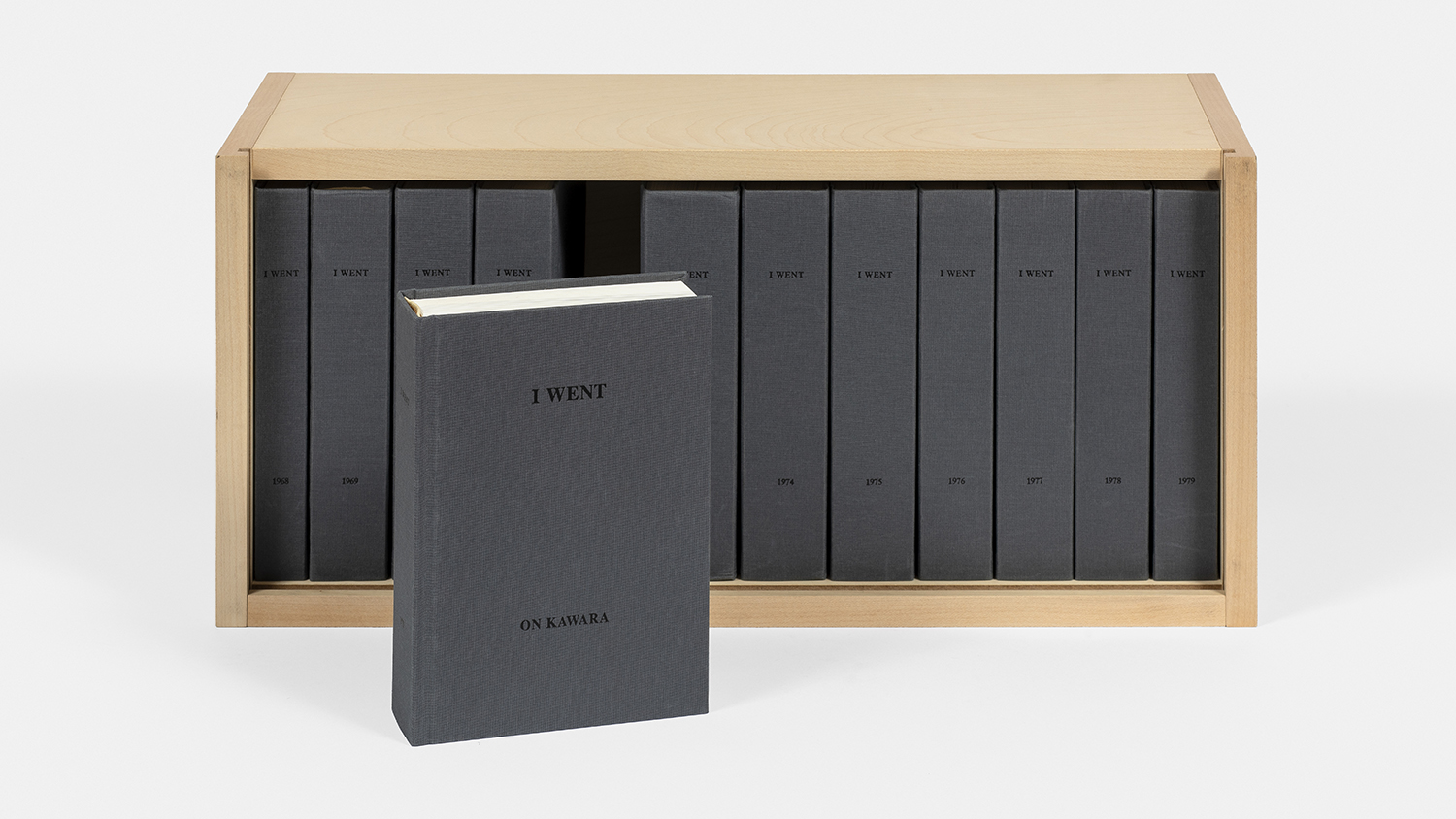
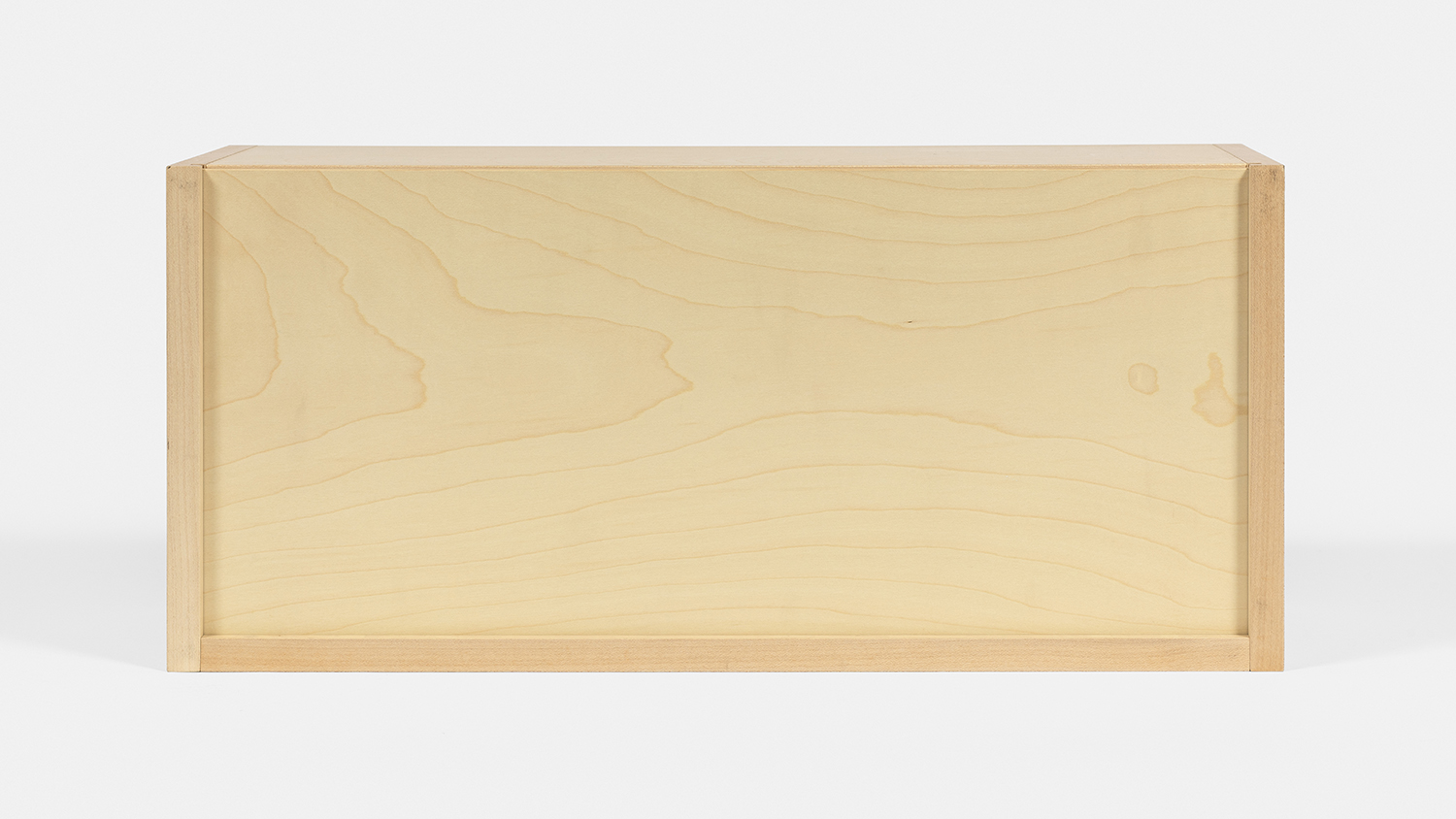
22.44 x 7.48 x 9.84 in ( 57,3 x 19,2 x 25,8 cm )
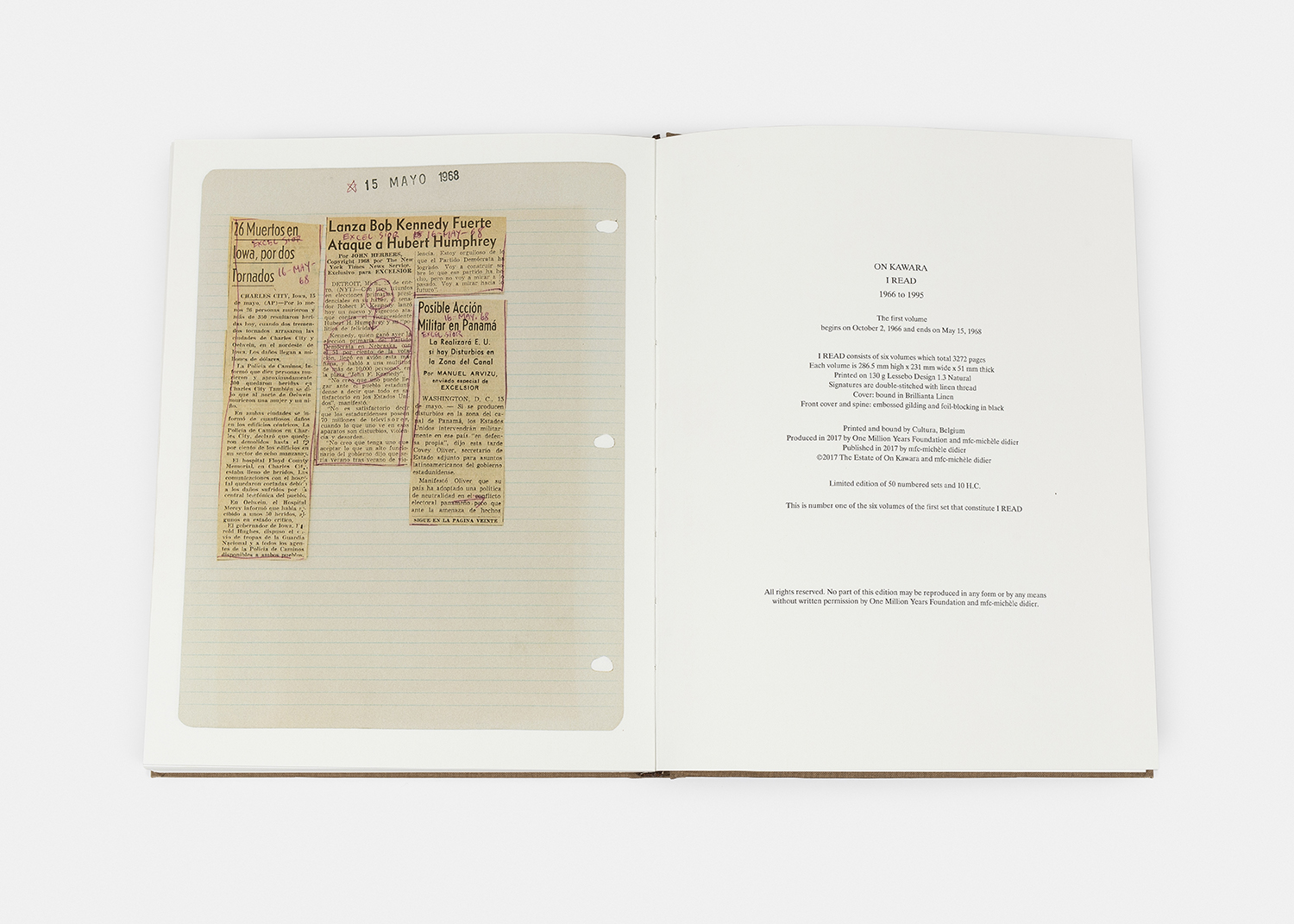
14.57 x 16.14 x 12.2 in ( 37 x 41 x 31,5 cm )
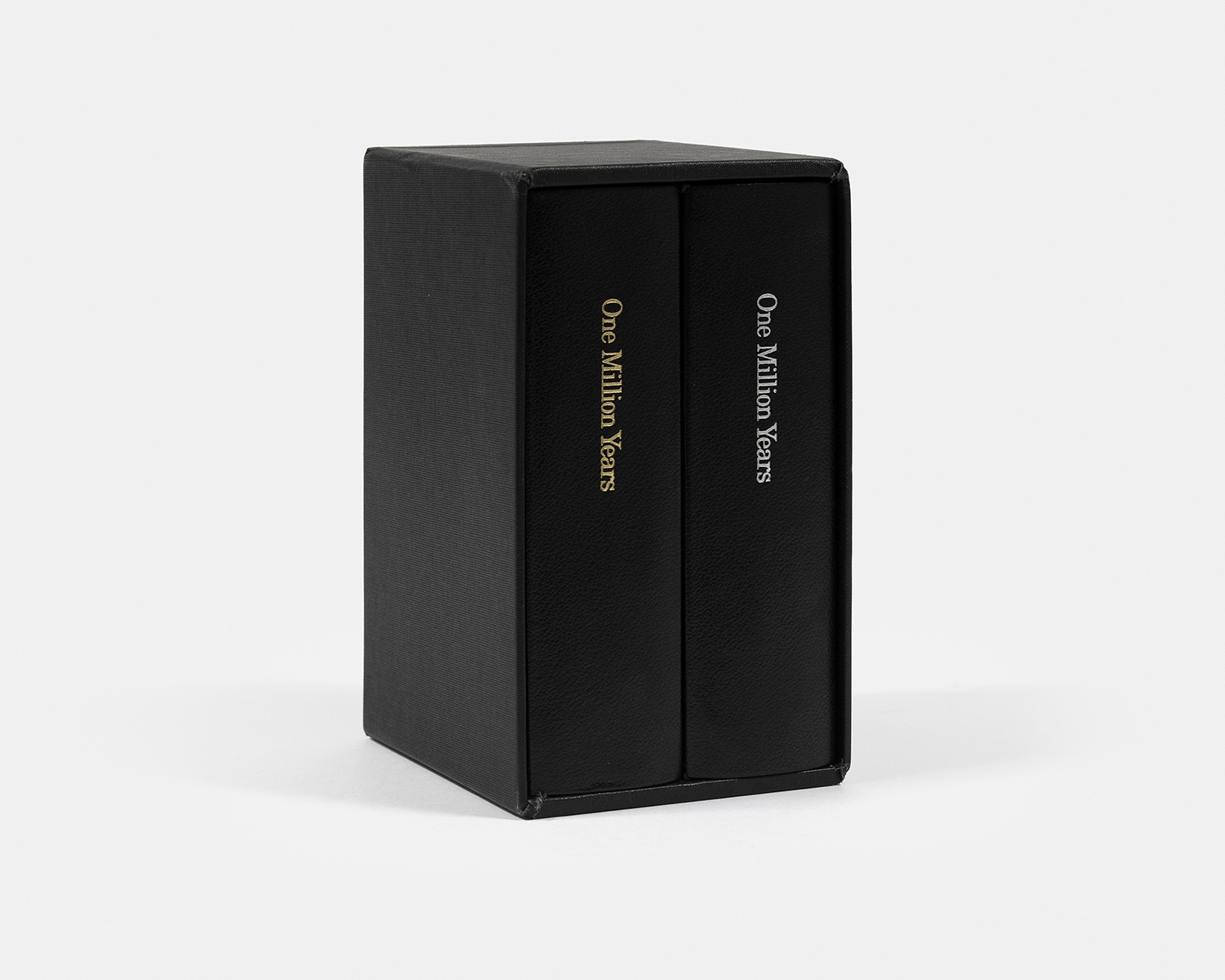
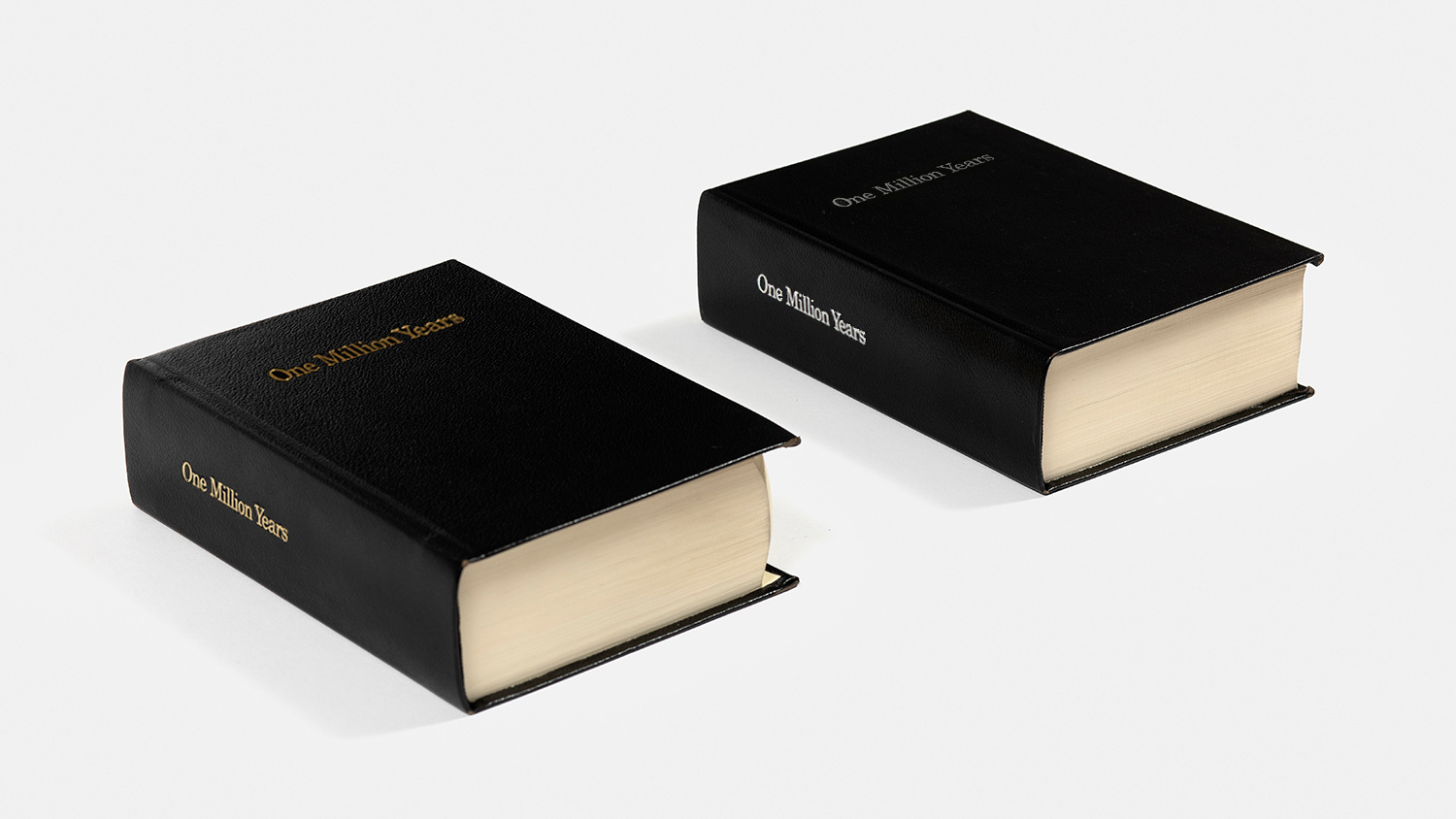
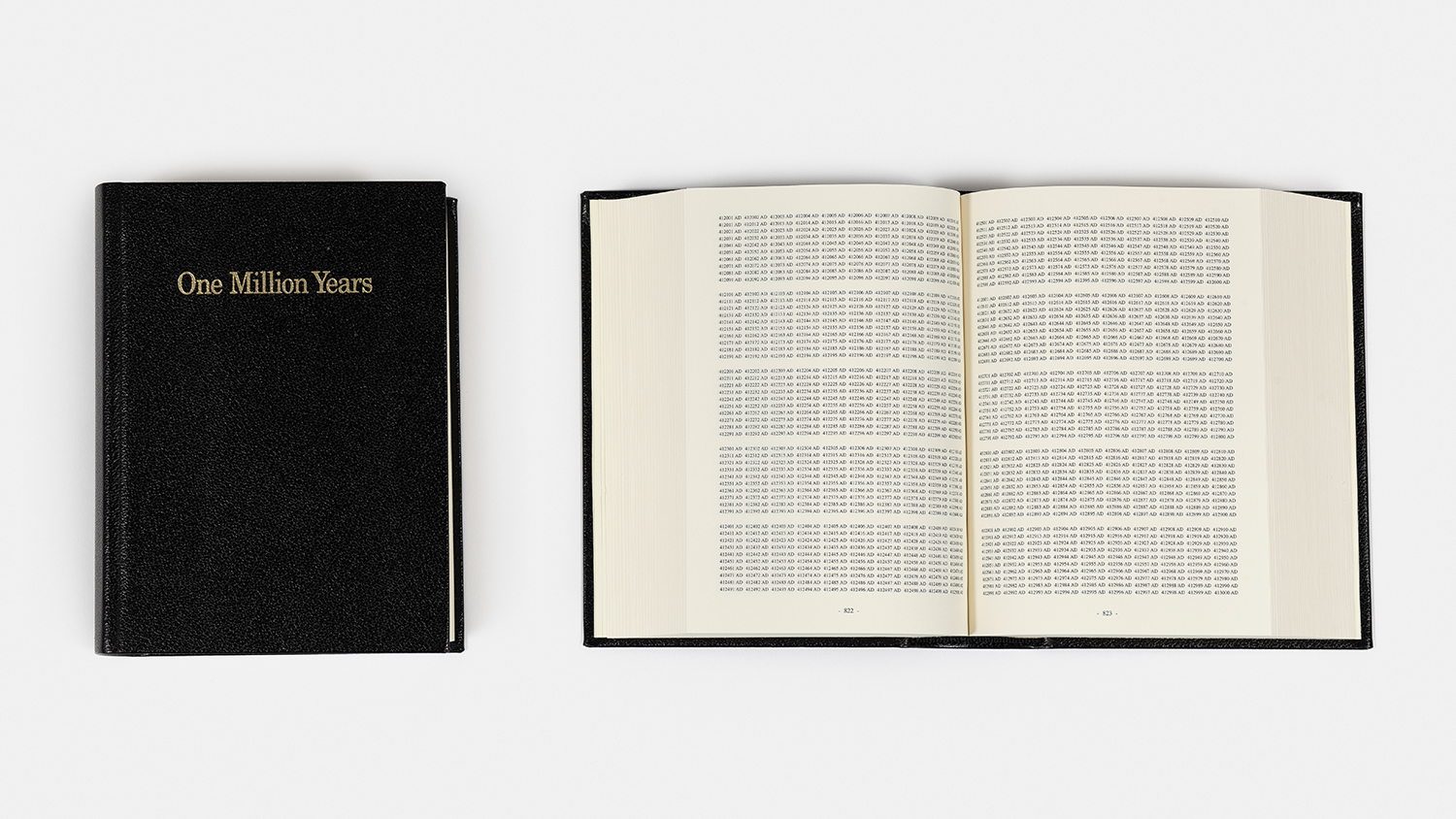
6.3 x 4.33 x 3.54 in ( 16,2 x 11,5 x 9,2 cm )